Which, of course, he is right to do. And, the commentators that put him in his place for basing his critique on his 2-to-7 year-olds' experience of a game meant for the pre-reading age, for whom learning how to play board games and take turns is as much of important lesson as decision-making, are equally right.
I think the answer we can walk away with, happy that we have successfully mediated this potentially violent board-game schism, is that we can all learn something for anything. Hossanah.
 What I want to write about here is not "healing the wounds", "bridging the gap" or "Peanut Brittle Houses". I want to write about blow the crap out of your siblings with the biggest pieces of military hardware known to man.
Battleship! (the MLA has decreed that it should always be written with the exclamation point) is another game that Johnson takes to task. He realizes just how boring it is when explaining the rules to his kids:
" I spend thirty minutes setting up the game, explaining the dual grids and how one represents their fleet, and the other represents their opponents’. I have to explain the pegs, and the x/y coordinates of the grid, and the placement of the ships themselves. And then when we’re finally ready to go, I explain how the actual game is played.“
So pick a random point on the grid,” I explain, “and see if he’s got a ship there.”
“Nothing? Okay, now you pick a random point on the grid.”
“Nothing? Okay, let’s do it again…”
I hadn’t thought about this until I actually played the game again last week, but there is absolutely nothing about the initial exploratory sequence of Battleship that requires anything resembling a genuine decision. It is a roulette wheel. A random number generator could easily stay competitive for the first half. But even when some red pegs appear on the board, the decision tree is still a joke: “Now select a co-ordinate that’s next to the red peg.” That’s pretty much it. Yes, at the very end, you might adjust your picks based on your knowledge of which ships you’ve sunk. But for the most part, it’s about as mentally challenging as playing Bingo. "
And again, he's right. The game itself is nothing more than a point of reference, so that later on in life when you learn about scatter plots, you can say to yourself, 'oh yeah, the Battleship! graphs.'
Which is precisely my point, though idiotically described: the point of games is much more than the rules of game play itself—the game is everything that is not the rules.
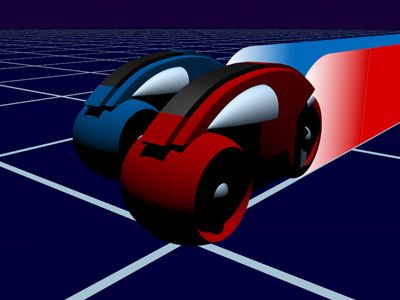 This could be taken as meaning, 'the point of games is not the game--it's how much fun you're having while you play the game.' Which is true, but I'm talking about other specifics. For example, as others commented in the original post: learning about Cartesian Coordinate systems. It is a side effect of the rules of the game. Nobody plays a game to actually complete the goal—you haven't actually sunk any battleships, settled Catan, or raced Light Cycles to certain death (or have you?)—you've played a game themed around the imaginary act of doing these things. In other words, the point of the game is not the game, it's the "playing". If it is fun, challenging, or a nice past-time then you play it. If it's not, you go do something else.
Which brings me to Battleship! My brother and I played many different games when we were young. Battleship! was always a good one, and we still play occasionally—I believe the last time was a few years ago. Our enjoyment of the game was on many levels. For one, we were (and in some ways still are) pre-pubescent boys, who played war in various forms, and liked simulated combat and military technology alike. A computer game that got a lot of play when we were younger (and it was still current) was Task Force 1942, a fleet combat simulator, which had its biggest points of real “action” in the gun view, where you could actually hit the space bar to bang away at pixelated ships on the horizon. Maybe we just liked boring games. We also liked the movie, Sink the Bismark! which is similarly a boring film, though basically historically accurate. We actually used to act out the gunnery officers screaming into their phones, "Foy-are!" (the German officer) and "Shoot!" (the British) while we played Battleship! This must have driven my parents nuts, almost as much as the viewer of the movie, forced to watch the exact same clips of the gunnery officers about three thousands times each in the course of the film. I was always the German—I liked the enunciation better. My brother always put a premium on being the good guys as well—I was, at various times, German, Russian, alien, and Confederate. It just didn't really matter to me. I was a fatalist from a young age.
But here's why I really liked Battleship!: I could win every time. Okay, not every time, but much more often than a Game Theory optimization of strategies would indicate. And this is no slight on my brother's analytic abilities. He was always more math-oriented than I, quicker at sums, and good at grasping statistics and logic. I was a bit better at visual geometry and calculus (though he may disagree), but he was quickly able to see the strategy in scattering shots across the grid in the checkered pattern, optimizing the ship-sized area covered with the fewest number of shots, even at a young age. After he caught up with me on the math, we were back to 50-50, at quits.
However, I gained the advantage when I realized the flaw in Game Theory—there is a way to beat the statistics, and it works every time. Cheat. And I don't mean peeking at his board, I mean cheat on what is the boundary of the “game” in one's strategy. Game Theory is based upon a clearly-defined game, in which there are a set number of moves. The way to beat the theory is to find the one move that hasn't been accounted for. Game Theory was invented by scientists with very little imagination (outside of their field, that is), and they always miss something. Want to know how to overcome a Checkmate? Throw the board on the floor. You're opponent can't win the game if you never concede to lose. Of course, this means they will probably never play with you again, but you'll never lose to them again either.
This “cheating” widens the scope of what is important to the game beyond your opponents view. Nowhere in the rules to Battleship! does it mention strategy. So what is the strategy? What are its boundaries? What are good counter-strategies? If I was thinking about this, and my brother was not, it could be to my advantage. This is why cheating is cheating—because you have extended the scope of the game beyond a defined boundary of what the game is supposed to be. I've played games of Monopoly with friends in which cheating is not a vague possibility, but assumed. The point of the game is now to cheat biggest, and best, without getting caught. A game can have any boundaries, or no boundaries, depending on who is playing what, when, and where.
This is why the Prisoner's Dilemma is bullshit. The boundaries are completely arbitrary and illogical. Any real criminal already has an unspoken death-pact in place to prevent such a dilemma from ever occurring. If one of them confesses, then his/her life is forfeit, and s/he can expect to be murdered before testifying, or soon thereafter. Why is that not included in the “dilemma”? And even under the outcome of confession (with a threat of murder or not), the real game is already over—the game of criminality. The game of criminality is that you have chosen to break the societal rules that incorporate such things as loyalty and defection. Therefore, if you attempt to take on a partner, you are opening yourself up to the possibility of betrayal. This is a social game played before the crime in even committed, and the prison cell is only the last move of an even bigger game. The Dilemma is meaningless, because the moves were decided in the context of a game much larger than extended or decreased sentences.
The same thing goes for Battleship!, even though I had no knowledge of Game Theory when I first discovered the fact. A random shot pattern makes the most sense if the placement of the ships is random--but it never is! The ships are placed by a person, not a computer or statistics theorist. Knowing your opponent is the battle; the ships are only the last move. Because of this I could confidently win at Battleship!, much as I confidently win at Rock/Paper/Scissor with people I know. I can see in my wife's face if she is going to go to Rock. The confidence says, “solid fist” all over it. After that, Paper is next in line. Scissor is the hardest gesture to make, so you can assume that it won't be chosen on the first round, unless you know a person really likes Scissor. Of course, if there is a tie the first round, they will probably choose Scissor next, to try and not have a tie the next round. They know, sub-consciously, it is the least picked. But why am I giving away all my secrets? Back to Battleship!
 I knew my brother liked his fleet to sail across his board in an orderly, real-life pattern. But, he would not be so foolish as to place them all in the same direction. That just screams “predictable”, whether I could predict that or not. So, at least one ship, probably two, would be facing orthogonally to the other ships, looking something like my spreadsheet diagram, to the right.
Once I hit a ship, I would have a pretty good idea where to look for the others by assuming such a distribution. If I guessed randomly, I would have only a random chance. This was only the beginning of my inclusion of "other rules" to my game. Another good rule is: if he is going to spread his ships in a pattern, then it is likely that one ship will be against the side of the board. This isn't a good place to start, because is often the smallest ship that gets stuck there, being placed last. But, if you are missing one ship and haven't hit one against the side, that's a prime place to look.
Looking at his face was another major part of my play. Any shot, miss or hit, would indicate whether I was a close call or far off in his facial expression. His poker face got better as we got older, but there were ways to bring it back out. Taking "irrational" shots would help. Say I had three hits on a ship, but no sink yet. An ordinary player would close in and sink. But, I would start shooting along my random pattern again. The relief that this would bring would put his guard down; if he showed utter relief then my random shot had gone wide, but if he stayed tense then I had another ship on the "scope". If, at this point, I managed to score a hit, and have two ships burning at the same time, the pressure would be too much, and I could read him like a map.
Then there were the counter-strategies. I remember the first time I taught him the trick of grouping ships.
 The look on his face as he banged away at all that open ocean while his flaming hulks vanished beneath the waves was victory itself. Of course, he eventually hit my ships along the bottom, and was even more distraught when I refused to admit that my aircraft carrier was sunk after he had hit five ship squares in a row. He never forgot that lesson. Afterwards, I could expect that two ships would be sailing in classic "Pearl Harbor Anti-Sabotage" formation (that is, close together to minimize exposure). Of course, I then re-taught him Pearl Harbor's lesson, when my near misses could easily catch a second ship unaware. He wouldn't over-commit with that strategy—but then again, neither could I.
Another way I would try and confuse him and reduce "open ocean" exposure to random shot patterns is by sailing end to end.
 This leaves lots of open space for him to shoot around, and even if he stumbles across half my fleet and figures out my nefarious strategy, the other half is still out there. And again, there is the psychological effect of having him make seven hits in a row without a sunken ship.
Once these strategies became known, I could expect them to be used back at me, and expect them I did. By looking at his face while he placed his ships, I could judge what sort of strategy him might be using. If he had a crafty look, he was probably trying something unconventional, like a close grouping. If he placed and re-placed, then it was probably a wider format, and he was making sure they were all spaced evenly.
Even after we, the two finest masters of naval warfare on my grandparents tile floor, had played through these different "mini-games", we would eventually grow bored with our tactics, and seek to improve the game in some way. This, I firmly believe, is the corner stone of any creative child's board game career. It doesn't matter how formulaic, random, or "zero-sum" a game may be if the players can re-invent the game themselves. We developed a system of moving the ships. I don't remember exactly how it worked, but I think it was as simple as you can move one ship one space per turn, or "maneuver", in which you can turn the ship 90 degrees using the stern as an axis. This makes the game much more than random—now the destroyer is at a distinct advantage, because guided correctly, it's small size could possibly evade being sunk even after taking a hit. It also made each ship a dynamic object with a "bow" and "stern", because this would deeply affect its pattern of travel. After hitting a ship, you had to figure out which end was the front and the back if you wanted to track it. Our navies cartwheeled, flanked, and full-stopped across that ten-grid sea.
We really wanted to introduce torpedo barrages and find a way to "Cross the T", but we never found a good way. I suppose a board does have its limits. Though not always: one summer my brother, my two cousins and myself set about designing a custom Risk board (which I believe is still in my parent's basement). We re-distributed continental boundaries, bumped the number of countries up to 150 or so, added new transfer routes across bodies of water, increased the number of dice to something insane, like 10, (though I can't remember why—maybe to make the game go faster?) and instituted sea convoy re-supply rules, in addition to the standard amount of treaties, doctrines, safe passage agreements, and cold war borders. I never could win at Risk. I think it was because I just wasn't comfortable sitting on the defensive. I would always go rogue, re-neg on all treaties, and rush my armies into a neighboring continent. This would give all the other players a reason to team up against me and force me out of the game, which is pretty much what the game is. It also didn't help me that the dice rules give the benefit of a tie to the defense, making the “charge” a lot less effective. I remember in college, when we had some heady, multi-day Risk offensives with troop numbers climbing into the hundreds and thousands, I wrote a simple program on my TI-83 to calculate troop losses according to the dice rolls. The program provided the option to go “to the finish”—in other words, continue to attack until one side was defeated. I was accused of faulty programming because the defense would always triumph. It was the math, I argued. With such a small number of troops at risk in any one “combat”, and with such a large number of iterations due to the large total of troops in the battle, the defense would always come out ahead. Now that I think about it, it also could have been due to the fact that the basic random number generator on the TI-83 was, in fact, too random; providing none of those “streaks” of good rolls that ordinarily allow a player to beat the odds. A rule to trump this could be added. The rules of Risk allow an attacking army to roll one die (up to three total) for each army unit attacking, as long as the defender has a sufficient number of army units to counter each attacker. But when the numbers are very large the attacker could be allowed to back each die by as many men as wished, and allow as many dice as desired. It could be explained in terms of attack fronts—the main front contains 10 units, and there are two flanking attacks of 3 units each. This way, the attacking player can determine his/her risk by choice, rather than leaving it up the accumulation of random outcomes. Of course, in large iterations the risk is the same, but the ability to create massive attacks gives the player the ability feel that s/he is overcoming attrition. And after all, isn't that the point of war?
I digress, but at the same time I think I make my point. A game is hardly the sum of its rules, or the spots on a die. A game is the social event in which one or more humans age 0 and up agree to a set of rules as a foundation of their interaction. During this time their may be competition, cooperation, challenges, creativity, boredom, aggressiveness, and even, depending on the game, sexuality. Sit in a popular bar one night, and try to develop the rules of human sex. It's pretty obvious--most people play by the same rules. I bet you can even create a comprehensive list for governing flirting in less that ten rules, in most cases. Of course, the real challenge, as with most games, is defining where the edge of the board is, and where the rules stop applying.


