Showing posts with label Iran. Show all posts

6/24/2009

Stones versus Guns

First of all, fresh in the news, is reports of a massive massacre in Tehran.


Sounds really, really bad. There's no way to say that without sounding understated. I've also seen pictures of axe wounds. Many sources claim the Basiji were wielding axes.

Fascist fucking thugs. As long as groups attempt to wield power, there will always be these little-man shits. I would call them animals, but that is a horrible thing to compare an animal, simply living out its nature, to these despicable wastes tickling their feedback circuits carving their violent psychotic world-views into other people's flesh.

I was listening to an unrelated interview with a biographer of Stanley Milgram today. Milgram is the scientist who did the "shock" experiments; the subject is told he is to administer "electric shocks" to an actor, on the authority of a researcher. Even though the actor pretends s/he is in incredible pain, 2/3's of the time the subject continued to give the "shocks", even though s/he was free to get up and leave at any time. The biographer said, when asked about the relevance to WWII and the Holocaust, that the experiment actually doesn't really explain Nazi behavior. It might explain the behavior of the train operators, taking jews to the camps, but the experiment cannot say anything about the creativity of torture--the soldiers who would compete with each other to torture more brutally, and the doctors who devised psychotic medical experiments.

I thought the same thing around the time of Abu Graib. I'm certain those soldiers were told that their torture was okay, but no one told them specifically what to do, nor to take photos of it, and put them on the Internet. Creativity--or what rudiments of it these people could find within their rotted minds.

There are certain people out there, who not only find themselves in the employ of fascist or fascistic leaders, to do their violent dirty work, but also, perhaps not unrelatedly, are also the sorts of psychotic power-thugs that get off on it. Is it enough to shoot people? No. They pick up axes, aim at children, and throw people off of bridges. There is no word awful enough.

As I said before, I'm always with the people. Guns against stones is what we so often see, and I think there is a reason for this. Any violent piece of shit can go get a gun and shoot people. But it is only the people that pick up stones to throw. It is not a pretty or romantic image--it is often the last act before getting gunned down. But it represents the fact of the matter--a finger on a trigger, versus the overwhelming anger of people en mass. I would throw a stone, if I could.

But this is nothing new. What is new, in some bizarre spin of the Evidence/Confession obsession of post-christian law, combined with a cyber-timed, techno-fetish Bataillesque-reincarnation, we can see these horrors playing out "in real-time", as it were. Our connection with the Internet provides a strange, more-real than real sense of the events. Of course, if we were there it would be unspeakably real. But because we are not, and can read the words of panic, and see the wailing relatives on grainy, uploaded reality footage, and know that it is not a snuff film, presented as "death in the lens", there is an uncanny realness that goes beyond theorizations of the simulacra. It is not uncanny in the sense that it is unreal; it is uncanny in the sense that it takes a medium of representation (YouTube, a normally all-too-surreal site) and forces it to be real in our minds. It is not just a depressing news reel. Looking at the video of Neda's death, I felt actual fear for myself being shot in the street. It is as if after nights and nights of hearing the neighbors get into a physical fight, one night the wall is transparent, and you can actually see them beating each other. Anybody with any sense knows that such violent crimes happen everywhere, all around the world, on a daily basis. But this is one happening NOW, and RIGHT IN FRONT OF US.

But of course it isn't actually happening live--Tehran is some twelve hours ahead of my location in time, and so I see the video after it has been uploaded, during my day time, while it may be 2AM in Tehran. It is part of the cyber-time extension--in which other places and times become co-extensive with my reality because I can access them so easily, in such "at will" format.

The problem is, there is little I can actually do. I can't go into the streets (protesting in front of an embassy is clearly not the same thing), and although one can do a bit to further the message, it is up to the people of Iran now.

I wonder what they will do. The pundits compare it to the '79 revolution--they take the shouts of "Allah Akbar" as the secret password: it is something to do with a rising spirit of Islam. Maybe a Islam different than other Islams the pundits have identified previously, but they are the Other, still.

I think it must be different. The Iranians are the ones holding the stones, but they know, regardless of what they might think about it, that we are behind them. When have the Iranians ever had the world behind them? Even if the people are defeated, or co-opted, or dissuaded, or killed, people do not forget things like this. Being assaulted by the state is not something you forget. The people are conscious of themselves, both in victory, and in defeat. When the Basiji shot Neda, they killed only one person, but they shot at millions of people. I've seen comparisons (by Americans, mind you) between Iran and 9/11. The people's wounds are the people's wounds--and like I said, the people do not easily forget.

Twitter and it's ilk, may not be the best reporting tools in the world. This may not be journalism at all. The networks are plagued by overzealous retweeters, misinformation, provocateurs, and just plain old spam. But you know what is exactly like that? A street protest. Nobody know's what is going on, but when that black line of cops starts advancing, you feel the electricity in the air. Nobody knows what's happening, but as they said once, everyone knows which way the wind is blowing.

So is this the cyber-time consciousness of the people? Are we linked in, not to information or social networks, but the mass itself? Only history will truly say, and by that time, it's really unimportant. But it is something to think about. There are right and wrong ways of doing many things. But think about the next protest, with a Twitter network dump channel, set-up in advance, showing anyone with an Internet connection what it looks like to get spit on by a cop, or get sworn at by some crazy anti-immigration protester. It's a pretty far shot from a coherent organization strategy, but it is a sort of consciousness. And consciousness might be the thing missing from activist movements for some time now.

But regardless of what it might be in the future, I know what it is now. This is consciousness; this is a way to not forget.

6/16/2009

Purple is for People

My blog is staying it's dark shade of purple.

Here's the deal about Iran:

It's tough to feel about it. I mean it is tough because there are such conflicting feelings for me, I have trouble isolating them for the purpose of explaining them, or forming any sort of theoretical guidance on the basis of these feelings. Not that anyone is asking my opinion, but this is precisely it--there is no lack of feelings, but instead, a wide flow of them, making it difficult to say nothing, and perhaps even more difficult to say something.

It seems that most Western media has turned "green", often literally changing their website colors to the color of Mousavi's supporters. This is an easy position to take, all the more so for people from the part of the world already opposed to Ahmadinejad. Being Western, and being generally, or at least newly-neo Liberal, it is easy to look at the opposition to the non-democracy as a vote for democracy. A voice against a stolen election is a voice for fair elections. No?

But what are we looking at here? At best, a journey from worse to bad. Mousavi does not represent justice necessarily, nor democracy, nor a new or free Iran. He is part of the regime. He has already ruled in Iran as prime minister, during the Iran-Iraq War, over the course of which 500,000 people died. I'm of the opinion that any leader who controls a country in fighting a war is not a leader at all.

Of course, I side with the anti-statists, the anarchists, and the opposition to genocide by states against people. I differ in this opinion from a lot of people, some of whom back America in such choices, in addition to any number of other "democratic" states. I take the strange position that any entity occupied in killing people for the sake of controlling them is bad for humanity. Therefore, as long as this occurs, the people are not free.

So when I see video like this, I become understandably upset.


As the man said, when I see a cop beating a worker, I know what side I'm on. Same thing goes for militia men shooting at people on the ground.

If I had to join a political entity, I would join Médecins du Monde. Started by Bernard Koucher after he left MSF. "The associations provide care to the most vulnerable without regard for sex, age, religion, ethnic origin or political philosophy."

Not to support democracy, not to provide one vote per person. To always support whoever is the most vulnerable. No countries, no gods, no masters. Only humans.

The liberal mind, on the other hand, looks for a body to join. They want a side, or a cause. I've already heard, on NPR's All Things Considered this afternoon, comparisons between Mousavi and Obama. When asked for evidence the election was fraud, the analyst said (I paraphrase) "It is like assuming that Obama would not carry the African-American vote." Wouldn't it be nice if every situation had a good guy and a bad guy, and all it took was to change the color of our Twitter avatar to the correct one?

I'm seeing a new sort of democracy, which I won't call a Twitter democracy. Let's instead call it a trending democracy. Less of the old left/right distinction, and more of the even older "go with the flow" distinction. Americans die, and we hang up a flag. Iranians die, and we hang up a green one. We boil down tragedy to a consensus of blame, and then make sure we show ourselves as against this blame. We, as good people, are against tragedy. For nothing, but against badness. It doesn't matter who it is, as long as s/he opposes this tragedy, and we will follow him/her right into the next one.

I don't know much about this Mousavi. But I do know that even if he won, Iran would still not be a democracy. If they can shut down the media, kill people in the streets, and act as they have, they are not a democracy. And even if Iran was America, the people would still not be free. Each motion forward is only as good as the number of people who are killed because of it. Greater than, less than, and equals to.

10/10/2007

From Your Living Room to Your Lebensraum

Let's take another fun Interdome field trip to... the Headlines!

Well, what have we today? Some auto union is striking... ooh, Lindsay Lohan isn't going out this weekend... (guess I'll stay in too)... and, well, hmm... but what have we here:

BUSH URGES CONGRESS TO REJECT ARMENIAN GENOCIDE RESOLUTION

Color me a-news-ed.

"But wait," ask the doe-eyed children gathered 'round the Interdome, "What does this mean?"

Let's delve into it, shall we? From the International Herald Tribune's 690 words on the subject, we learn that this resolution to name the murder of 1,000,000 Armenians in 1914-1918 a "genocide" could hurt our political relationship with the modern Turkish state, and therefore we shouldn't do it. It appears that the resolution is simply a push from some "interest groups" whose interest is that considering their cultural heritage, they would have qualified for the death camps back then.

This isn't the only recent time that American government has struggled to figure out what the definition of "genocide" is. In fact, the American government seems to have lots of trouble with definitions of words. But, I digress.

If we only read the IHT's article on the vocabulary discussion, we might just move onto the next headline, because, frankly, "genocide" is not a very happy word of the day, and there certainly is a big Interdome out there to read. But, for some retarded reason, I guess we are going to dig a bit deeper.

Turkey, as the IHT tells us, is one of the main transit points for American war supplies heading to Iraq. Therefore, improving relations with Turkey allows the Americans (let's try and pay attention so we don't get "Armenian" and "American" confused, eh?) wage war in the Middle East.

However, the actual way of things is that American-Turkish relations have been declining. After the Truman Doctrine established that Turkey was seeking support of America against the USSR (and other pro-Communist groups like the PKK--remember this, we'll come back to it!), an American military base was established in Turkey in 1954, that is used to the present day. But, ever since the end of the Cold War, and the end of the nice balance between East and West to divide the world, relations have been strained. Turkey has continued to be pro-US in order to support their foray into the EU, among other things, and they have backed this up by supporting American wars in the Middle East and recognizing Israel as a state despite how this has hurt them in their Middle East/Islamic relations.

So, for a country through which "the bulk of U.S. air cargo and about one-third of the fuel headed for Iraq passes," quoth the IHT, it would be important to keep them happy. So would a resolution about the Armenian genocide really be a thorn in the Turkish thumb?

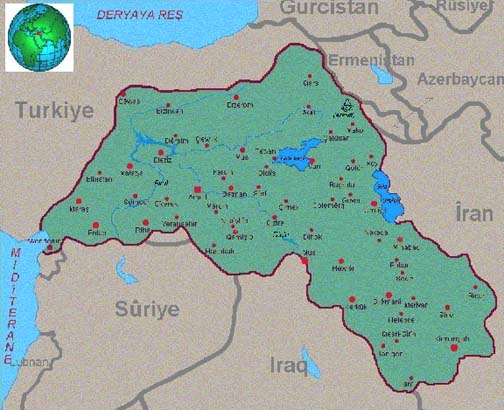
Well, Turkey is not only a convenient conveyor belt to the hole in the desert into which we're currently pouring money. Like most so-called "resolutions", the matter itself is less resolved than other, more important, "strategic" things are alluded. Turkey is also the primary target, and major operating base of a group called the Kurdistan Workers' Party (PKK).

The PKK started in the 1970s as a Kurdish nationalist political group, and escalated to the level of a paramilitary organization. It's philosophy was Marxist-Leninist to begin with, but now has shifted to the Islamic hue post-Cold War.

These days, they are a "terrorist-organization"--a vocab word that was agreed upon by the US. The US has helped Turkey fight the PKK, allegedly with the CIA, and also through NATO paramilitary "stay-behind" forces that were placed in Turkey. The object of these forces was to remain hidden in the population so as to "stay behind" to conduct guerrilla operations in the event of a USSR invasion, but they were often utilized, at who-knows-who's behest to conduct paramilitary or domestic terrorism operations.

But, oh-so-surprisingly, in this crazy post-Cold War world things seem to have been getting confused. It seems that some of the weapons that the US has sent to Iraq (most likely through Turkey), you know, those weapons the US can't find, have ended up in the hands of the PKK.

And what's more, that very-lucrative-and-increasingly-popular contracting company Blackwater USA has been accused of directly smuggling weapons to the PKK! Horrors!

Now, why would the USA be smuggling weapons to a formerly Communist, avowedly terrorist, separatist group that they are simultaneously fighting in order to court their allies?

Why indeed!

Although I hardly claim to be in the neo-cons' brains, I would say that it is something along the lines of...

The PPK is a separatist nationalist group that while not having much of a positive effect for its own policy, is currently involved in destabilizing the ENTIRE Middle East region, and specifically the governments of Turkey, Syria, Iraq, and Iran.

Why would it help US policy to destabilize the region? Well, they've certainly done a good job of it so far, I don't see why they would not use any tool available to them to continue. Regardless of other positive and negative outcomes of the Iraq War for American interests, destabilization is an outcome that has only benefited the economic, political, and ideological status of the United States. And, if they didn't want to destabilize the region, there are certainly other ways they could be going about this project. Intimidation, fomenting armed conflict, and cross-border operations just speak so loudly, you know.

Meanwhile, back at the ranch, Congress is occupying its time with a history lesson on whether the killing of 1,000,000 or so constitutes a certain word, something that the New York Times had reported some 90 years ago. That's a pretty good way of avoiding a current problem.

It really boggles my mind that it so easy to hide the killing of millions in plain sight. I guess that the typical person, and by this, I mean the overwhelming majority of the population, just doesn't care about these sorts of deaths, especially if they occur on the other side of the globe.

It certainly never stops. Turks kill Armenians, Germans kill Jews, Poles, and others, Sudanese kill other Sudanese, Americans kill Iraqis, and others. You know what the estimated numbers are dead were for the Iraqi Economic Sanctions, even before the war started? The same as the Armenian Genocide, 500,000-1,500,000. It never stops.

I guess we'll conclude this field trip with a quote, from a guy of whom you may have heard, who goes by the name of Adolf Hitler. It was said during a military meeting in 1939, before the invasion of Poland.

"I have issued the command -- and I’ll have anybody who utters but one word of criticism executed by a firing squad -- that our war aim does not consist in reaching certain lines, but in the physical destruction of the enemy. Accordingly, I have placed my death-head formation in readiness -- for the present only in the East -- with orders to them to send to death mercilessly and without compassion, men, women, and children of Polish derivation and language. Only thus shall we gain the living space [Lebensraum] which we need. Who, after all, speaks to-day of the annihilation of the Armenians?"

Where does American economic-lebensraum lie today? You can manifest that destiny for yourself, but one thing is certain, that were certainly have trouble to-day speaking of the annihilation of the Armenians.

4/25/2007

Why Haven't You Learned Anything Yet?

I'm watching Bill Moyers Journal on PBS right now. He's reviewing media coverage of the lead-up to the current war (don't you know there's a war on?) starting since 9/11. (That's 9/11/01, as opposed to the other 9/11's that happen every year. Also, it is different than 9-11, which is the number you call on your phone in an emergency, as I heard a Virginia Sheriff refer to it on the news recently.)

It's a wonderful program, going over a horrible thing. Bill Moyers rarely disappoints. He cites almost every single network, outlet, and paper in how they have stood up and lied along with the government in order to push the case for war. In addition he refers to pundits by name, numbering the times they have flat-out echoed lies.

The sad thing was, I knew all of this before the war even started. Not because I am smart, or because I had done a lot of research, but just because it seemed so obvious that the ideas proposed were full of shit. Neo-cons all of sudden deciding that a country that they had sought to control but had gotten out of hand was a threat and so why not spread a lil' bit of the ol' democracy over the area. I didn't know if there were WMDs or not, frankly, it didn't seem to matter, because Iraq didn't just decide to go out and pick them up in the "post 9/11 world" (that we were reminded so often that we were living in), they either already had them, or they never had them. Same thing with Al-Qaeda. Why would anyone believe that all of sudden "it was revealed" that there was a link. For anyone paying attention, we were tracking Al-Qaeda for years (ever since they stopped being our puppets, ours and the Iranians, that is...) so why, after 9/11 would we all of sudden find out (from people we were paying off no less) that "there the were!" hiding in Iraq. Ridiculous. Yet, presented as the "truth".

[find out more about the history of the United States and our so-called enemies' common causes at the excellent site, Cooperative Research; all sources are from the media; it is amazing that among the lies you can also find the truth, its just on the back pages and nobody connects the dots for you.]

I don't mean to be arrogant, and I don't want to say "I told you so." (Well, at least not very much.) I think the real point is that this idiocy is not going to stop, but just re-cycle. Iran is next. Again, it doesn't matter whether or not Iran has nuclear weapons. What matters is that we want to prevent them from forming an oil burse, we want the oil fields adjacent to Iraq, we want to continue to spread our influence in the Middle East, and we want to counter the influence of the SCO (see my recent post about the building war against Iran, and again, Cooperative Research.) But none of this is in the media, only the specter of the "threat to us". Whoa.

The media is full of tools, and that is why I never trust anything that I will ever read, hear, or watch to be fully ingenuous and conducted under the spirit of actual research and enlightenment; in other words, I expect the media to be completely devoid of truth. That doesn't mean that there are not facts. They are just hidden, watered down, misappropriated, countermanded, and obscured. It requires research of one's own to be able to actually piece them together.

Anyway, you should check out the Moyers piece. Here is the link to the transcript, but it is not up yet due to the show being so recent. I'll check back and make sure the link works tomorrow. And for goodness sake, think about what you are reading! Don't let them lie to you with a straight face! It's like the goddamn Ministry of Truth out there...

4/03/2007

Iran, so far away... (Part 1)

The current events involving Iran and Allied strategy in the Middle East have drawn my attention to the little-known history outside of these events. Iran has become the crux point of the future of American hegemony in world politics, and the direction that this crux could lead will spell out the future of the United States and also determine the epoch of what "post-cold war politics" will really be about. This is literally history in the making, and therefore I think it is important to tie some information together that is being completely missed by the media, otherwise these facts may go unnoticed until far in the future when the ability to take a political stance is gone, and a historical stance is all that is left.

Although the structure of my narrative may change as I tell it, I'm going to divide this topic into two parts, for the purposes of making my blogging easier, and perhaps also easing the reading and following of the threads (and hyperlinks) that I will weave. The first part will be a (very loose) background on some relevant parts of "near east" politics in the last decade and a half; the second will look more closely on the United States conduct toward Iran in the context of that history. Hopefully by depicting a closer, local picture in the context of the larger strategic picture, the fragments of truth that are available might fit a narrative of understanding.

A caveat: the mere digging into the unreported (or at least, unfocused) aspects of the United States' foreign policy almost automatically takes the appearance of what is popularly known as "conspiracy theory". If a conspiracy is a hidden plan, and a theory is a guess at the meaning of evidence that would lead to a theorization of the goals of such a plan, then obviously, speculating on secret military and diplomacy policies would qualify under the description. However, where such theorization differs from the popularly held notion of "conspiracy theory" is how far one must jump between points of evidence in order to connect the dots. In this day and age, there is so much information that the relevance of information becomes decreased to a infinite minimum by the sheer weight of the totality. For any one person to be a "witness" to the complete picture is highly doubtful. Thus bureaucracy obscures itself amid itself. But what we can do is catalog the facts that we do find noted by others, and beginning to observe trends and waves of events that can be linked together into a theory. This I what I will seek to do. I do not intend to show that there is someone "behind" what I will describe, or point blame. I think it is a given fact that a government will seek to act in interests that are meant to remain secret from the general population. But by looking at events, we can see the general direction of what is being attempted, and this is what we call history. I'm not going to say we have an ethical duty to compile history- but we do compile history, all the time, and at different levels. This is what is going to go on here.

Part 1: East and West

In 1996 there was the formation of a group known as the Shanghai Five, made up of the states China, Russia, Kazakhstan, Kyrgyzstan, and Tajikistan. In 2001 these states and Uzbekistan formed the Shanghai Cooperation Organization. The claimed effect of the founding (from the SCO website) was that "It initiated new global vision with regards to security, containing principles of mutual trust, disarmament, cooperation and security, enriched new type of interstate relations started by Russia and China, with partnership, not union as a basic; provided model of regional cooperation with such distinctive features as joint initiative, priority on security, mutually beneficial interaction of big and small states. This new world vision has raised human society above cold war ideology and made an invaluable contribution to creation of a new model of international relations."
While the claimed principles sound very nice, some conservative theorists have looked upon this organization as a way to counter the influence of the West in southern Asia, an as an alternative to organizations like NATO or the EU. (Belarus was not considered for membership on the basis that it is a European and not an Asian country.) The resolution calling for American forces to be removed from Uzbekistan and Afghanistan and the planned SCO joint military exercises are other factors that contribute to the military weight of the organization as an inter-national organization to consolidate Asian forces apart from Western forces.
Although there are no current announced plans to add additional member states to the SCO, Mongolia, Pakistan, and Iran have all applied to be members after being granted observer status in 2005. India, also an observer state, has not applied, and this could be India hasn't decided if this is the bloc for it to join. (The SCO opposed the enlargement of the UN Security Council permanent membership, while Japan, Brazil, Germany and India were for it. Perhaps China and Russia wanted to consolidate their power in that organization, while simultaneously forming a non-Western bloc under their own influence.)
It is not clear whether these observer states will be invited to join, but the fact that they express interest in joining belies precisely that; they are interested in this organization that has arisen as a counter to Western hegemony.

This is a general tide, or current, in international relations. Another current that has of late been whipped into a maelstrom is that of Islam in Asia. While this has been heavily reported, especially since the 2001 terrorist attacks in America, the reporting has often taken the stance of "Islam and the West" while ignoring the currents within Islamic countries that are often more political than their are polemical. Since the invasion of Iraq by the United States "Sunni" and "Shia" have entered the media vocabulary, but still the history of these relations among various countries and most importantly, the various political groups that actually constitute politics has been ignored in favor of general, ideologically understandable divisions. The fact is that different organizations from different countries with different iterations of ideological belief have been at odds and/or evens for years, creating a political climate that cannot be understood dualistically, despite the desire of the media to create an easy story. If only the weather was as simple as warm or cold weather, perhaps meteorologists could always predict the conditions.

I won't describe all the relevant conflicts in detail, but I will link to the wikipedia articles about them. They provide good synopses of the relevant parties involved, and also this list is an illustration of the size of the issue here. There is more than enough history involved to fill a semester-long class, and most media sources try to tell their stories in a few hundred words.

Middle Eastern Conflicts


The Arab-Israeli Conflict: Involving all the countries of the Arab League, Israel, and numerous factions all of these countries and groups

Jordan-Syria tensions: Involving tensions between monarchist and socialist governments, pro-Western pro-Arab tensions, support and opposition to the PLO and its factions, the Muslim Brotherhood and its branches

The PLO Internal Conflicts: Fatah, As-Sa'iqa, and some ten other factions and their various periods of unity and division

Lebanon: from the Civil War to the ongoing issues with the recognized government and Hezbollah

Iraqi-Kuwaiti Wars: Involving long-standing border disputes, post-colonialism issues, nationalisms, and oil resource disputes

UN disputes with Iran and Iraq: sovereignty and international politics over nuclear and weapons proliferation issues

The Iran-Iraq War: Involving long-standing border disputes, religious nationalisms, racial nationalisms, oil resource disputes, and Western interference


While all of these issues and events are interrelated, I want to focus on the Iran-Iraq War as a prelude to what is occurring now along that border, although now the United States and Allies in a much more obviously involved position. Part 2 will begin with that analysis, and show how Iran figures into that local history, the larger global scene of Asia and Europe, and the currently unfolding events. In the mean time, do your homework! No one is going to learn about history for you, jerk! Not even me!