Showing posts with label modernism. Show all posts

12/16/2009

Welcome to Nauru

Okay, this is great. Well, no, actually it's not. It's not at all good for the people of Nauru, but it is a hell of an archetype of colonial and post-colonial modernism. This is literally a story of our age, and it's totally true.

It reads like a classic SF plot, an amalgam of Herbert, Dick, Asimov, etc, incorporating all the cultural-critique sci-fi into one big recipe, kind of like soggy nachos, or some sort of over-supplemented chex mix. It's just so perfect that it's like a modern political economy action figure, with all the play sets and vehicles. It's the post-modern blogger's upside-down airplane stamp. It's a truth that is a fable that is real that is a bedtime story.

It's perfect tragedy. It's a story so hopeless negative, that we might cling to it like a live saver in the middle of the pacific ocean. It's the sort of story colored by sadness, that wins countless awards, and receives standing ovations and tears of joy from the people who never had to feel such pain outside of a story.

It's history. It's current events. It's the future of people we will never know, and the future of all of us.

All right, let me stop trying to tell you what it is, and just let me tell it to you. And remember, this is not based on a true story, but actually is a true story. (All stories are better with Wikipedia links, right?)

BEHOLD, THE LEGEND OF NAURU.

Once upon a time (a time that is the ever-present now), there was an island in the Pacific called Nauru. It was/is a small island, of only 8 square miles. It was the smallest sovereign island nation. Let me tell you how it came to be that way.

Sometime in the murky ocean of prehistory, Micronesian and Polynesian people inhabited the island. These happy-go-lucky islanders joined the unstoppable march of history in 1798, when British whalers happened upon the island. You may remember whaling as the original failed energy model; ships sailed the seas looking for these large mammalian oil sacks, spiking them, and then bringing them home to light up the industrial revolution. It was the first time we fucked that old problem of energy up good. Now there are hardly any whales, and we've moved on to fucking up other things.

Whaling, coincidentally enough, kind of fucked up the people of Nauru too. The whalers traded the islanders firearms and alcohol for food. Then, with the firearms, and probably both with and without the alcohol, there was a ten-year Tribal War from 1878 to 1888. Imagine a ten-year war on an 8 square mile island. Can you? Well, the population of the island was reduced from 1400 to 900 during that time.

Luckily, kind of, Nauru was annexed by Germany in 1888. Then they got Christianity, which at least was better than ten years of tribal war across 8 square miles of ocean isolated land. Things were pretty much Christian for the next 10-15 years.

Then they had some more bad luck. Phosphate was discovered on the island, which was used to produce explosives and fertilizer back in other places where they had more room to farm and blow up stuff. The phosphate got there because birds had been stopping to expel waste on the island for thousands of years. So these Europeans with land to farm and explode created industrial colonization companies that no doubt scared away most of the birds, first under contract with the Germans from 1906, and then under the British after 1914, when the island was captured by Australia, precipitated by a period of time during which the Europeans were busy blowing stuff up back home at a much faster rate than usual. Imagine the times back then--wars engulfing trenches in flames and poison on the other side of the world, and meanwhile some industrious folks were sailing around the Pacific, capturing little rocks with valuable stuff on it, all the while feeling totally connected to that war somewhere else. They were globalized! Colonialism is crazy!

230 islanders died of influenza in 1921. Fucked by Globalization!

And then, another of these crazy wars happened in and around 1940. The Germans came back and blew up a lot stuff on the island, and then the Japanese came in 1942 and took all the Nauruans away to work for them for free on other islands. The Japanese also brought airplanes, which the Americans promptly came and blew up in 1943, but then left the island alone for the rest of the war because, after all, it was pretty small. The 737 Nauruans who survived their forced business trip came back in 1946 with the British, and everybody tried to get back to work.

In 1968 colonialism was becoming post-colonialism, and Nauru totally became independent. They are lucky they became sovereign when they did, because it is a lot harder now than in 1968. In 1970, the Nauru Phosphate Corporation was formed, so the islanders could strip mine their own island. They spoke mostly English now, though they still have their own native language they continue to use for non-business purposes. Taking over their own island was a good idea, because then they could colonize themselves. In the early 80s Nauru had the highest per capita income in the world.

But there was something about bubbles brewing in the south pacific...

In the mid-80s, it became clear that the island was actually only 8 square miles large, and that the phosphate actually was going to run out. So, they sued the Australians for environmental degradation. After all, they had mined it first, and for way longer, and the environment was, after all, totally fucked. The post-colonizers paid out of court.

But the islanders had to find some other way of making money, because their only resource was gone. Like most other people in the world who have happened into money, they decided to invest. Like most other people in the world who invest, they fucked it up and lost a lot of it.

From a high of 1,300 mil. AUS $ in 1991, the Trust shrank to 138 mil in 2002. They lost their money in the usual ways: bad investment in real estate, bad loans to sports teams, hotels that weren't as profitable as they were supposed to be, and even a musical (YES REALLY A FUCKING MUSICAL) that closed after one night. Their airline, Air Nauru, had its only 737 repossessed in 2005, when other airlines around the world were also fucked. Until 2006, when they got their airplane back, the only way to get to and from the island was by ship. Nauru does not have a seaport, though.

Like true failed investors, they returned to basics. "What," they might have thought, "does Nauru have that other countries don't have?" The answer, it seems, is nothing. "Well, in that case," continues the potential argument, "what does Nauru have that every other country also has?"

The answer, is sovereignty.
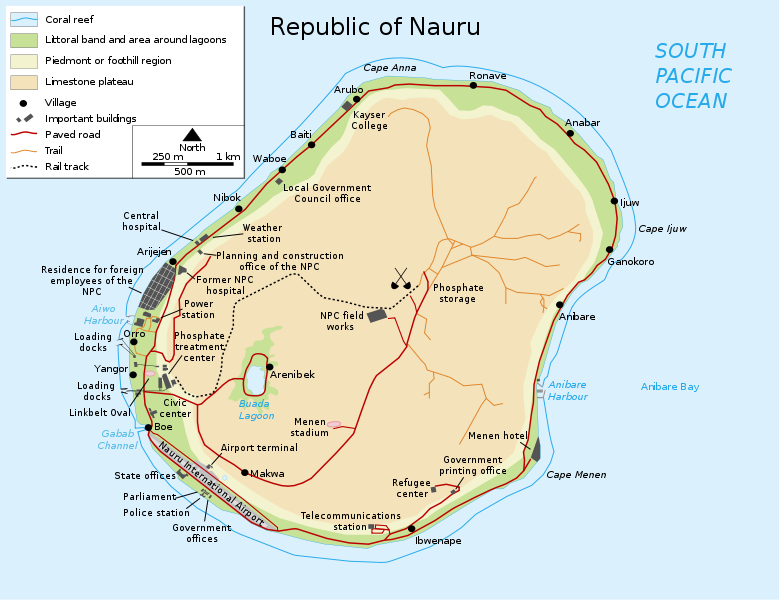
When you have honest-to-goodness land, no matter how little, and a seat in the UN, you are somebody. And so, Nauru has managed to get money from those looking to buy a little sovereignty. Starting in the 90s, Nauru opened itself up as a tax haven, by offering passports to foreigners in exchange for a fee. This brought in the usual money laundering crowd, and of course, their money. In those heady days, you could start your own bank for 25K, "no questions asked." In 2001, Nauru agreed to be the "Ellis Island" for immigrants seeking asylum in Australia, (part of the so-called, if you can fucking believe it, the "Pacific Solution" [!!!]) and operated the Nauru Detention Centre in exchange for foreign aid. Between 2002 and 2005, there was a bidding war between Taiwan and China to decide with whom the little island of Nauru would establish diplomatic relations. In 2007, when Australia closed the detention centre, the Nauruan government estimated 10% of the population would be adversely affected by the job losses. Things looked grim. But just recently, reports suggest Nauru has received $50M US for becoming the fourth country to officially recognize the breakaway Georgian region of Abkhazia. It's unclear exactly who paid, but it looks like Sovereignty (TM) is back on the menu.

Sovereignty, which is this smallest of island nations defining trait, and the last lingering effect of colonialism, seems to be the main source of promise for this oval in the ocean. Today, the unemployment rate on Nauru is 90%; and of those 10% who work, 95% are employed by the government. From 1798 until 2009, the story of history has just been one long red carpet for Nauru, leading to one place. Post-colonial countryhood. Nationalism really is the only game in town.

So the moral, dear friends? Well, as tiny Nauru said:

"God bless Nations, Every One!"


Okay. Serious time.

I don't mean to make light of Nauru's ongoing troubles. But there is something about the troubles of an isolated nation most people have probably never heard of somehow resonating so perfectly with the troubles of the entire globe. By reading the story of this little world-corner's microcosm, as it blossoms into a full-blown paradigm of post-colonial woe, those who have never been and will no doubt never go to Nauru, and probably never meet anybody from Nauru, nor met anyone who has ever been or ever will go to Nauru, might just feel a tinge of what one might call, "entertainment". As if we were listening to a tragic story. Because what is a fictional story if not a fully believable world that resonates with our own, that we will never be able to experience other than through the story? This island's problems are no less real than any of the other problems of millions of people we will never hear about. And yet, when we hear the story of this island, it is like we are hearing our own problems read back to us. We polluted our natural spaces with violence, disease, and chaos, and exported war to import natural resources, until we couldn't anymore because they were all gone. Then we turned right back around and funded more wars, to keep that economic heart pumping, to keep forcing blood back into our mouth, to get what sustenance we could. We made a few good investments with our ill-gotten gains, and squandered a lot more on bad investments. And lately, it is all looking like it's going to come crashing down. So what do we do? Build a system that works? No, we turn around and sell what's left of our independence for a few more bucks, like a long-gone junkie. Beg, borrow, and steal, as the saying goes.

It's not as if Nationhood ought to mean more; it's not as if it wasn't already a prostituted use of a society's self-worth; it's not as if selling it off for what you can to feed yourself is any less noble than any other last, lacking spasm of economic juice left to dry out in the spinal cord of our species' cultural body.

It's that after all is said and done, and you've cut the last tree and burnt the last oil, Nationhood is all you have left. The golden ideal is the last thing to sell, because it never was real. After you sell the bricks to your house and the land underneath it, all you have left is the ideal: the cross-stitched "God Bless This House" sampler without a wall to hang it on. After you sell your furniture and clothes, and use up your strength and resolve, all you have left is what your body might mean to someone else. We clearly don't care that prostitutes sell sex--we turn around and buy sex by the ton on the TV. If we could buy sex from a vending machine, we fucking would (any day now). What we look down on is being in the position when you don't have anything left to support your body but the body it's built on. You can't make anything; you can't build anything. When you're truly at the bottom, and when you're truly fucked, the only thing left is to take the last iconic symbol of human existence, which for the prostitute is our culture's ideal of fully exchangeable sex, and take it out to the street and sell a fuck for whatever you can get.

Unfortunately, there is no redemption here. No heart of gold to be laid bare once the body is stripped naked. Nauru is trapped by the rock that once was its chemical mine, and now is the rock it has to make interest payments to buy the jet to fly home to. No matter how degraded the prostitute may be, s/he still has to close the same eyes of the same body to get to sleep every night. Ideals are the basis on which the transaction is accomplished. The end of history may very well such an inversion--when the ideals of history become its bent, tarnished tool. The spear of destiny is the cane we'll use to hobble into our graves. There will be nothing left to tell, except the same story over again.

Actually, there is one step lower. It's when you take what's left out to sell, and there's nobody out there willing to buy.

5/14/2009

And lo, we have invented a new technical variety of literary wrongness

FUCK! Gerrr... ahk, goddam... fuck!

Okay, I'm doing it.

I promised myself that I wouldn't. But here we are.

I promised myself I wouldn't write anything about Tao Lin or Muumuu House. And yet here I am doing it.

I wasn't going to, because everything obvious has been said by his detractors, of which it seems there are a certain number (like anyone with an Internet presence). And second, what good would it do, really? There are plenty of shitty artists, artists I don't agree with, artists that fall short of their pretensions, and everyone in between. I try to only call out the people who really make me angry, or of whom I think I can make a good example for a particular point, mostly unrelated to the actual person. Attacking someone personally rarely has a positive effect outside of the rhetorical.

But as I said, here I am, and here we are.

I think the fact that he keeps being interviewed is what has brought us here today. Not who he is being interviewed by--some blogs, maybe written up by Nylon or TimeOut. (I would like to see a hipster Left Behind in which every person, place, or thing written up in Nylon, Paper, and TimeOut NY are suddenly vanished from the face of the earth, and those of us left behind actually go out on Friday night and have a pretty good time.) It is all about what he says in his interviews, which really gets me.

But it isn't a "grind my gears" sort of get. It's hard to explain--and this is why we are here.

I read his blogposts to Muumuu House, and his interviews because it is inspiring to me as a writer. We have some commonalities. We both write, and we both aspire to publish ourselves and others whom we admire or appreciate. But he does it in the absolute, complete opposite way I would ever want to. I read his Internet presence because everytime I do, I feel better about my own work and more determined to continue.

I don't mean that I think his work is shit, or even that I don't like it. I think it is absolutely wrong.

This is the opposite of what they teach you to say in liberal arts general-absorbtion-nontheoretical-aesthetics, otherwise known as "upper-middle class culture". They teach you to say, "it's writing, sure, but I don't think it's very good; I just don't happen to like it." Contrary to this, I would say this is the wrong way to write. I believe it fails.

I'm not attacking his format, either. I am all about blogs, Twitter, Gchat, or whatever else. You want to generate writing in new ways, go right ahead.

Tao Lin writes in what he refers to as the style of "Kmart Realism". If you have never had the experience, there are some pertinent examples on the Muumuu House site. I haven't seen him actually describe his own writing in these terms, (which is important, and I'll get to it in a minute) but he writes an essay on Kmart Realism here, a genre in which he groups Ann Beattie, and then in this interview he claims to mimic her work, so I suppose that is a fair, round-about Internet presence self-indentification if ever there was one.

I myself am not to certain what Kmart Realism refers to, or its context, other than feeling as if I generally get the joke but don't specifically enjoy it. For your own reference, I suggest you check out the work on Muumuu House, because I don't know anything about the other writers he references, and don't really care in relation to this.

Call it what you will, it is what it is. It is short-worded, choppy sentences, presented actively, with no metaphor, few adjectives that aren't treated as states, ("I felt weird.") loose descriptions if any, an overall first person tone, a psychological poise (lots of talk about how narrator "feels"), an auspicious ironic tone, and a certain misplacement of ideas that passes for humor.

It is, regardless of what a high school English teacher might think, literature. I can accept that. I, for one, seriously admire an adherance to a form. Most writing these days is so overarchingly auto-narrativistic without realizing it, it makes me want to burn things. I appreciate an approach which makes this tendency the rule, by making it obvious and part of the style. I also can appreciate the terse, shortness for what it is (as long as it lasts, which thankfully isn't long). Additionally, for a time I myself thought of swearing off metaphors, until I decided to embrace them completely. Despite my own writing's difference from these points, I can appreciate someone who sets out some rules, and keeps them as part of their art.

Here, in the same interview as previously linked, Tao Lin gets about as close to describing his prose as he ever does:

TL: The next two books are really detached. It has no adjective. They’re just told as simply as possible.

EN: Do you feel personally detached…?

TL: No, the prose style is detached. There’s no judgment or rhetoric at all. It will just say if it’s a house, it’s a house. It’s also lacking em dashes, semi-colons, similes and metaphors.

He does this sort of thing well, and he and his associates write pieces that still can be read, despite slashing long-proven elements of the English language out of their tool box. For this they should (probably) be congratulated.

But, I still don't buy it. It's still wrong. Not because they are revolting some sense of English-language hegemony deep within my phallus, but because I don't believe they are rejecting anything. Why throw out semi-colons? Why em dashes? Why not en dashes? Why not exclamation points? There aren't many of these in their work either. What is the argument for any of this? What is the rationale?

But, as I imagine the argument, it's not really about a logical argument for these tactics; it's about a feeling.

Oh wait, I didn't imagine that at all. He said it, in the interview. Numerous times. Let's count all the times he talks about how he feels.

"I feel like I’m reading stuff like I’m reading fiction. If it’s amusing I’ll feel excited, even if it’s talking shit about me."

"If I’m writing something that feels like a gimmick, I try to avoid that. I don’t think the term gimmick… I don’t know."

"Well, on my blog, it’s really how I am. I feel like that’s what I’m thinking, just not what I’m saying."

"I don’t feel like I put personal stuff on my blog. If I do, it’s just a lie. Because I treat it as a work of—not fiction—but a work of art. I delete anything I feel uninterested in. I go back and edit. I want someone who goes to it read the entire thing and feel like they’ve read a novel or something, instead of someone just talking without editing."

"I feel like some people will edit everything they do. Some people will just not really edit."

"Without the internet, I feel that I would have a job right now…"

"I feel like probably people wouldn’t want my life because I don’t have any money. With writing, I’m surviving in the way anyone could survive. This is just what I chose to do. I’m not really like living off of writing. I’m not willing to get a real job. Most people in my position would feel a lot of pressure to get a job but I just… don’t like jobs."

"No. I think most people probably have higher expectations that me. Especially NYU students. Maybe that’s why I don’t feel like I’m living the dream."

"I don’t think I think in terms of humor for my books. I don’t feel like I’m approaching it in that way. So it must be different."

"If I wrote all my other books right now they would be different. But I just feel like that’s a natural change. I feel like I’m always gonna keep changing. Not for the better or the worse. So I wouldn’t change it."


Okay--there are a lot more, but I'm tired of hitting Ctrl+C.

Clearly Tao is writing from his "feel", or maybe it's just one of those verbal ticks we all have.

Or is there a difference? Doesn't it seem as if the construction, 'I feel ____' is the foot of his sort of writing? Isn't the writing sort of an ongoing answer to the Twitter perennial, "What are you doing now?" which the introverted, melancholics of the world read as "What are you feeling now?"

Here's a piece from Muumuu House's website, "SELECTIONS FROM CHRIS KILLEN'S TWITTER ACCOUNT BY CHRIS KILLEN, EDITED BY TAO LIN". Reprinted here, absolutely without permission.

2:39 PM Mar 14th
lay in bed for a long time, 'twittering' in my head. tried to remember what i had 'twittered' last night. got up. put on dressing gown. etc.

2:50 AM Mar 14th
listened to man on radio in taxi with 'strong opinion'. panicked mildly that i would never have a 'strong opinion' about anything.

10:53 AM Mar 16th
possibly going to eat a banana in a moment.

11:00 AM Mar 16th
still haven't eaten the banana. what am i doing?

11:01 AM Mar 16th
i feel like i have 'twittered' myself into eating the banana.

1:41 PM Mar 16th
i feel like i am 'twittering the mother-fucking shit out of everything' today. i feel like i am in a fast, open-top sports car.

2:22 AM Mar 16th
my penis feels like a day old glass of water, with bubbles and a bit of tobacco in it.

2:22 AM Mar 16th
my penis feels like a CD i never listen to anymore.

2:23 AM Mar 16th
my penis feels like a curious old gentleman climbing a flight of stairs and then stopping halfway up to have a stroke.

1:47 PM Mar 17th
i am eating a blueberry muffin.

11:57 AM Mar 18th
it is 'blueberry muffin time' again.

4:13 PM Mar 18th
my leg feels strange.

4:15 PM Mar 18th
@jennashworth hi, babes.

2:19 PM Mar 20th
just watched a video on the internet explaining how to fold a t-shirt.

2:22 PM Mar 20th
just tried to look at the alley at the back of my parent's house in kenilworth on google street view. wasn't there.

Now, here's another piece from the site, "Relationship Poem" (OH GOD THE TITLE IT BURNS ME) by Brandon Scott Gorrell:

on the couch i kept asking what was wrong

you said that nothing was wrong

then you said it had nothing to do with me

then we turned on american idol

and only talked about american idol

later we went to bed

and gmail chatted the next day

using 'ok' and 'i don't know' at a frequency that seemed higher than usual

i was on the 5th floor of the downtown public library

sitting next to an obese teenager

who was listening to death metal on her ipod

i minimized our gmail chat and looked at the escalators

mentally projecting myself minimizing our gmail chat and looking at the escalators

then the music on the obese teenager's ipod switched to r&b

it was interesting


Pretty similar, huh? Interesting, indeed!

The good part, which is sort of bizarre, is that despite this petty stamping of the "I feel ___" phrase, whether literal or metaphoric--(you see, the thing about metaphors is you can't just write about something like a blueberry muffin and have it not be symbolic!) it is not writing that I definitely don't want to read. I like it a hell of a lot better that talking animals and teenage vampires/witches. But what are we reading?

We are reading, short prose, with little form except for what it avoids. We see:

-No long, complicated words (adjectives or otherwise)

-no metaphor or simile

-Little or no punctuation

-state description only

-very passive tense

-Nothing serious or attempting to be profound

-Only the first-person narrative

-An ironic self-reference to its own terseness by a grappling with larger, not exactly metaphorical, yet symbolic subject matter of the distinctly personally-narrative, i.e. (I feel "___", quotation marks included)

Is it all ironic? Is Tao Lin's interview style a continuation of his writing style? Is this terse-first-person meant to be involved deeply with what it "feels" in order to be more of a terse, first-person? Are the quotation marks, as the only form of often-used punctuation, meant to be a ironic use-mention form of the author's self-reflective but sparse use of words? Is every word, put in "quotation marks" or not, really a substitute for "I feel"? Is "feeling" the only real verb here? Are we meant to be looking inward, only to find there is nothing there?

wait a minute.... this all seems oddly familiar....

ON THE HIPSTER QUESTION

Is that what this is? Hipster writing? Short, un-artistic, form-as-gimmick, I-drink-beer-like-I-feel, living-in-williamsburg-is-so-damn-hard, Hipster bullshit? Has my attention been drawn, against my will, to the literature equivalent of an ass in skinny jeans?

Let's ask Tao about it:

EN: I read somewhere that you say you write for depressed hipsters. Why do you want to appeal to the hipster crowd?

TL: I try to think of a hipster I can’t think of a specific person. When I think of hipsters in general, they are just people who care about what’s happening now. What they look like… and also… most of that is so they can find more friends. I like all those things. I also feel like they’re like the only people who read books a lot, except for people trying to be writers.

EN: So do you have that audience in mind when you’re writing?

TL: Not when I’m writing… but… yeah, when I’m writing. Cause those are like… either those people or people who are interested in those people … those are the people I’m interested in, in terms of like, talking to and being friends with. In that sense, I target them. In the way I talk about it in interviews and stuff, I’m half joking … those are people who I think read books are, so I’m gonna target them.


Very suspicious.

Firstly, he "can't think of who that might be". Sure, I believe you live in Brooklyn and can't think of any hipster in particular. Even ride the L? Ever go to a bar? Ever go to NYU?

But then he figures out that would be a hard one to get around. Yes, it is the audience he has in mind when he is writing. He admits it.

However--I don't believe Tao Lin is a hipster himself. But what he says, for a "feeling" about who his hipster audience may be, is pretty apt: they are simply people in whom he is interested. People who read books, who might read his books, and who he would know on that basis. A bit scattered in terms of phrasing (edit much, "Bomblog"...?) but pretty honest.

There are many reasons to dislike hipsters. They gentrified your hood, they bought all the good records, they wear shitty clothes, they don't know how to make a good espresso, etc. This all falls under the general, catch-all hipster problem--they are a bunch of clowns who somehow are found everywhere you want to be. It's as if the Insane Clown Posse fan base stopped hanging out behind the drug store, and are now drinking in your bar, going to your favorite DJ night, and generally convinced half the nation's youth to do the same thing.

But this problem, which we are on to here, is separate from the unfortunate fact of hipster fashion. Tao Lin is not interested in hipsters because of the way they dress, but because of the way he feels. What is this link? What is causing his writing to take this dry, ironic, self-referential tone, without riding an 80s skateboard or buying all the good drugs? It is a gene carried by many hipsters, no doubt, but I believe we are looking at a totally different cultural chromosome's allele.

Let's give it a name: Emotional Singularism. That's a bit dry, so for the practitioners of this condition, we will give a nickname: Feelies.

In Emotional Singularism, we are re-visiting Cartesian dynamics, in a most-time appropriate way. In this era of graphs, datapoints, curves-as-linguistic-and-political-architecture, plotted points or the continuation of such points have a currency all their own. You want to be relevant? Show us a graph. You want to hold weight? Plot us a curve to stand your narrative upon. Run it through the points of You, Me, Iraq, Global Warming, George Bush, and make sure its all within the same plane of general consumer-liberalism. There, now you have momentum. It takes three points to plot a distinct curve, and if you read any persuasive essay, you will note at least three points, fixed in a cultural plane, with a nice, sloping approach drawn through the three of them.

But what is really important is the vantage point--the crossing of the axes. From this point, we measure everything. For Decartes it was the abstraction of the verb, "I think"; thinking denoted being. This is a cold, rationalist, metaphysics. It was the axiom of the geometry, and as easily forgettable.

These days, we don't care about the axioms. We just want to see the pretty curves. So we've withdrawn back into the crossing of the axes, without Kant's interest in the suppositions of the axioms, and the necessary philosophical internalization of the geometry of metaphysics into the unconscious (time, space, what is that like?). Rather than analyze the significance of the word, "I", for its own pre-conditions and metaphysical systems, Emotional Singularists are happy to take that singularity as fact. After all, they feel it. And there, they have found their new conscious substance for the pursuit of truth. Hence, their own personal emotions are the singular point on which they base and measure their world.

These days, it's enough to feel. You can debate metaphysics, or get lost along its lines of logic, but with feeling, you can never go wrong. Truth itself is called into question, but we have not yet called feeling into question. Instead, feeling is growing like a vectored weed, directing behavior, politics, economics, and even, so it seems, literature.

You know who these feelies are. We called them Emo for awhile, when boys holding acoustic guitars somehow picked up on a bizarre congruency with the feelings of a great number of record buying teenage girls. But the Feelies are still out there. They are the hipsters feeling self-conscious because they don't know if their fashion and friends are enough. They are the man/woman crying and yelling at a man/woman because s/he gets confused by his/her sexuality's mixed messages. They are the people who don't really know about politics, but have still decided they really don't like politics. They are the people who do one thing, but wish something else. They are the people who just don't feel comfortable with any number of things, and therefore try to avoid those things. They are the people who do not speak, but instead go home and cry.

Emotions are our friends, but they are not replacements for thoughts and words. It works like this, I believe, in actuality: there is some crazy business going on in our unconscious, which we never really understand. This craziness manifests itself in feelings, projected upward from that dark, unphysical undercurrent. These feelings then must be wrangled, absorbed, translated, and mechanized with words. Only in words do we have the ability to deal with the undercurrent of emotions. They don't always work, and if they don't, we throw out the words and start again.

Somewhere along the way, it got uncool to think too much. Maybe between the viscerality of the 60s and 70s, leading into the unholy terrors of thoughts flowing through the 80s and 90s, we felt we would simply be better off not knowing. Or maybe to be hip in knowing just got too difficult, so the eggheads like Foucault and Derrida could worry about that, but the common man was just going to do a bunch of coke and start talking about the fire in his loins at the speed of light. This substitute for actual thought, this rambling realist (or alternatively, speciously new age) hype-speak took the place of the actual definitions of words, the difficult terms of metaphysics, and the technique of linguistic construction. Feelings, those ever-flowing semi-conscious perception, could be packaged and sold as language without a second thought. Ever see one of those adbuster-esque packages, proudly titled, "plastic junk!" a little gag gift plastic nugget-thing wrapped in plastic? The joke is, people actually buy those; a gag in which the gag is that there is no gag. People actually like repetitive, sacarine emo music. They even go to see it played live, just like it is on their CD at home.

Feelings are not words in themselves. It is not enough to say, "I feel weird; I feel nauseous." Because you have a feeling you are not fully able to describe, it is not enough to simply call it "weird", and then describe the discomfort you have with your inability to vocalize it as nausea. Sure, I believe your stomach hurts. But who give a shit? If you drink enough, or do enough chaw, your stomach will also hurt. If you lick the pavement for long enough, you will get nauseous. If you are simply nauseous, I couldn't give a fuck, because you might as well be a fish floating upside down. Oh, something went wrong, and the fish is dead. Was it poisoned? Overfed? Underfed? Drowned from not enough oxygen? There is no way to tell, so I throw it in the toilet and go get another one. I probably even give it the same name.

Hipsters are just as infected by the Feelies as everyone else, but not because they wear clown shoes. It's something to do with our times--a certain wrinkle of modernism that's only metaphysical advance over the past fifty years was to start thinking there was no need to pay attention to the subtle vicissitudes of language anymore. A current in our culture that decided to outsource deep-thinking to the philosophers and focus on stomachs. A specific element of our society that believes it can learn more about themselves from daytime TV chock full of commercials specifically manipulating their emotions than by actually conversing with any person. Watch the commercials playing during an episode of Doctor Phil or Opraha. What is the show? What is the commercial? Which is manipulating your feelings? Which is telling you real information?

So, yeah, you go online. Somebody listens to music. Your girlfriend probably hates you. Man, that's some weird shit. How interesting. How about maybe you stop feeling, just for one second. Instead, why don't you try and write an original thought? Just one. To see if you still can.

Here is a new poem, written by you. In one line, you describe exactly what it is that you did that caused the last fight with your significant other. If you actually do it, trust me, it will be beautiful. (Write it in the comments or email it, and I'll post it.)

Well, Tao Lin--your work with Muumuu House is interesting stuff, I'll give you that. But I wonder if it is interesting because of the reasons you thought it was. Or did you and your writers even bother to stop and think about that?

5/10/2009

Batter My History, Modern-Archetypal Opera


I first saw Doctor Atomic in the HD Live MET performance, which was an interesting intersection of opera and technology in and of itself.  At ten in the morning Pacific Time on a Saturday, Megan and I dragged ourselves out of bed and down to the mall multiplex, where we purchased popcorn and sodas, and sat upon a completely grey-haired audience to see live opera beamed by broadband in digital high-definition from the MET in New York to Portland, Oregon.

There are probably some pretty heady archetypes flowing in that alone, but we'll leave it generally alone right now.  Let me just say, as much as I love to get dressed up and go out to the theater, ballet, opera, etc, it is pretty awesome to see one of the best opera companies in the world perform in crystal, digital clarity for twenty bucks within walking distance, while slouching in my seat and eating popcorn, besides.  Sure, people my own age are more interested in seeing the next comic book movie, but hell, as long as they keep doing the HD Live series, I'll be checking it out.  We also saw Faust, which was great, but I do have the complaint that sometimes they do too many close-ups with the camera work, not letting me fully take in the amazing sets.

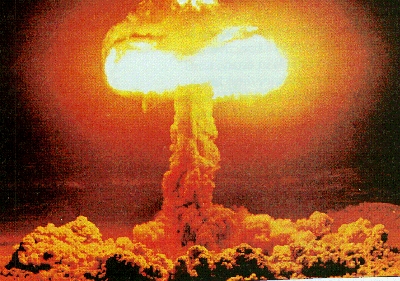
But let me talk about Doctor Atomic.  It has been pretty well talked up in the media for several deserved reasons--for one, it is a new opera written about a modern-historical theme (Oppenheimer and the Trinity test of the first atomic weapon); two, it is actually a remarkably fantastic opera, already performed in three cities since it's premiere in 2005, leading many to speculate it may be a new canonical piece of work, which in these times of pretty shoddy additions to the canon, is nothing to sneeze at.

I, for one student of history and amateur opera appreciator, think it is a masterful work.  While I hate to predict the future, speculating about this piece joining the ranks of works like Doctor Faustus is intriguing, and interesting on several points.  Keep in mind as I speculate, I know very little about the dynamics of the aria, and am focusing on the liberetto, which is really for the best of all concerned, my musical knowledge being what it is.

Opera, of course, is a medium bursting with archetypes.  Even more so than our most famous plays we find in opera the most characteristic plots, themes, and characters, if for no other reason, because the production's bombastic incorporation of full orchestra, magnificent costumes and sets, and the extreme ranges of the human voice lends itself to the biggest, the loudest, and the most impressive.  But even more than that, it is straight-forward, direct, and without any irony, which in this day and age is a sort of victory for the form in its own way.

The canonical operas include archetypes of many sorts, incorporating, dramatizing, and commenting on the range of human behaviors.  Doctor Atomic does no less, but this is not simply the reason for my enjoyment of it.  It guides its archetypes, explores them, and for lack of a better description, puts them on stage and let's them perform the crap out of themselves for two acts.

The main archetype, in my estimation, is that of fate.  I am not big of speculations of fate, myself.  I have my own appreciations of the metaphysics of time and space, which are not really relevant here, but it strikes me nonetheless as a useless to worry about whether or not there is such a thing as free will.  This is not the archetype we are dealing with in this opera--not the struggle of so-called free will against fate, in the classic Oedipal rejection of the will of the gods, or even in Hamlet's own struggle to accept facts and move on from there.

My favorite Shakespeare play has always been Macbeth, because I think it deals with fate most truthfully.  Tragedy is unavoidable.  This does not mean each person is destined for tragedy, or if one is predicted to have a tragic destiny there is simply no avoiding it.  What it does mean, is upon being inflicted with horrible tragedy, there is absolutely no way to go back and say, "if only such and such had/hadn't happened, this tragedy never would have occurred."  Causality, and hence tragedy, does not work in this way.  Because tragedy was the result, everything previous can be seen as leading up to that.  If Macbeth had never been killed, his encounter with the witches would have been just, "like, really weird, man."  My images of Macbeth are drawn from Kurasawa's Throne of Blood, (because it is awesome).  When the forest itself is coming to tear down the fortress, and when our man is stumbling down the steps of the towers, being filled full of arrows by his own men, it is not time to say, "gee, I never should have listened to that old man in the woods."  That's fate for you.  If you're fucked, you find it out when you're fucked.  And then, simply, you're fucked.

And this is precisely the attitude we should be taking towards the atomic bomb.  You and me, we're fucked.  They already built the damn thing, and used it too.  There is no point in debating historically whether or not it was a good decision.  If you come to the conclusion it was a bad move... so what?  It still exists.

And this is the moment we are at when the overature lifts, and the opera begins.  "We believe that energy can become matter, and matter can become energy, and hence be changed in form." We know laws of physics.  This is essentially a physical opera, because it deals with fate as fact, especially when it is historical fact.

I have read that the historical fact of the opera is not perfect.  It does take creative license with the characters and some aspects of the plot, even though the liberetto is derived from almost entirely historical sources.  But this is not the point either.  The historical fact of the opera is the climax--the detonation of the Trinity bomb.  This happened, and there is no going back.  We have had over sixty years to talk about it, and the opera is only two acts long.  But no matter what the actors sing, or what the audience concludes, the opera still ends in the same way: with nuclear fission.  This is its, and our, fate.

But this was no act of god--hundreds of men worked to make this occur.  We know this as well.  We know the history of the war effort, even if few of us alive today experienced it.  This part of the fate as well, a train moving forward, not out of control, but driven and directed by a mass of humanity.

The first scene begins with Edward Teller and Oppenheimer at a black board, doing math frantically.  This opera's plot--the construction of the most powerful weapon in the world, which could in fact destroy the world--is naturally compared to other operas with similar magnitudes of plot.  Wagner's Ring series also involves a weapon, and Faust also involved horrible, deadly, demiurgical power.  But these are not titans, or fantastical beings forging a weapon on a hearth of hell-fire, nor magicians making deals with supernatural forces.  These are scientists, doing math, extending their knowledge to the furtherest possible application of the rule in the physical universe in which they lived.  The universe in which the opera exists is one of total war, when every person's efforts are devoted towards defeating an enemy with deadly force.  They knew the Germans were working on the bomb, but after Germany surrendered, they first wondered about the direction in which this locamotive was heading, now that it was up to full steam.  After Germany's defeat, the world could become social again--that is, concerned with social issues.  This is a recovery from Auschwitz already beginning, even though the full depth of the horror was not widely known.  Morality again comes into play, after the Reich falls.  It comes back into play in both in self-judgment, and in judgment of others.

The title of the discussion the scientists have about the bomb goes by the almost whimsical name, "The Impact of the Gadget on Civilization".  They got together and discussed, and some of them became active in their opposition of its use after it was created.  Not that this was done in poor guidance of ineffectively, but the scientists were scientists, and not masters of social issues in the way they mastered physics.

Even at this point, an attempt to put on the brakes looks almost ridiculous from our perspective, in full awareness of what the fate will come to be.  The bomb will be dropped, and it will be dropped because it was made.  It was used on Japan for the rational reasons, to stop the invasion, to force surrender, etc.  But as Edward Teller's line goes, "The more decisive a weapon is, the more surely it will be used."

Hiroshima was selected as a target for maximum casualties of a visible nature.  This was not a weapon to use behind the scenes, or sneakily, or as a veiled threat.  This is nothing less than the fated, Biggest Bomb, and it could never have been anything other than such.  Seriously, can we imagine a world in which the atomic bomb had never been used as the weapon that it is?  Can you imagine a world in which we had waited, and a war developed in which multiple parties had the bomb, and it had never been used?  Perhaps the real fate, and the real justification (as much as you can justify anything in the past tense) of using the bomb was not for the Pacific War, but for all the wars in the future.  Maybe we survived the Cold War by nuking Japan.  But that's a lot of maybes and perhapses for a discussion of fate.

You can't justify or revoke any more than any of the scientists could have stopped what happened.  It was simply going to happen, in our plotting of the events now, by virtue of the fact that it did happen.  This is the fate we all have to deal with now, and this is the archetype--fate is what you have to deal with as its happening.

Gods, as we knew them, die on the day of Trinity.  Humans become gods, uncapitalized.  The opera is filled with religious symbolism and adapted lines, because this new archetype of fate--that we might have to deal with a fate so horrible as to destroy our world with a murderous deux ex machina rather than one of salvation--is not so much a reputiation of religion as a summation of it.  You can forget the specifics of theology, but you had better remember the awesome horror of the cosmos.  This is what the scientists discovered when they saw in a pillar of radioactive flame that all one really needed to have the destructive power of gods was to do an amount of math, and have the will to go through with it.

Hubris has nothing to do with it, and regret or forewarning has nothing to do with it.  It is all about humans, their hands and their brains, finally completing the cosmology they had conceived of thousands of years ago in the bible, in the vedas, and in their other archetypical nightmares.

An interesting aspect of the opera is the fixation on the weather.  They are waiting for the weather to clear so they can do the test; they are not sure if it will work, and they need to be able to measure the effects, and there is also concern about radioactive waste being blown back on the people.  Despite their imminent fated ascendance as gods, these men still can't control the weather.  They do not have the will of god, they only have the titanic weapons of physics under their control: and this, only barely so.

The power is not new; its the same duality of construction and destruction humanity has been wrestling with since the first ancestor clubbed another with a stick.  It is simply that it has become the archetype, as it seems it was fated to do; suddenly with Trinity, we are able to increase the power of destruction/creation to the limits of our own imagination and understanding--which really is a pretty incredible thing.  To imagine the limits and to exceed those limits in action.  It is the occurance of fate--of the lining up of the mind and physical reality in a way that seems to say, "this is what is meant to be"... whatever that means.

In the atomic age, in seems we have surpassed many of the old archetypes, or rendered them irrelevant.  Maybe this is why opera has been losing its hold on our culture.  What could we possibly show in a set and with instruments that we can't see on the news, or hear warnings of in the news?  Archetype has accelerated to reality, and we're left in sort of a stunned, modern haze, not really sure if we are fated to be here, if we have somehow violated a fated time-space and are stuck on a train running towards a cliff--or maybe such notions of our imagination about what things mean and are supposed to do are what is running towards that post-modern metaphorical cliff, while we stand uncomfortably holding all these atomic bombs.

We don't have a melody to sing, and John Adams music in Doctor Atomic is quite poignant for its lack of typical melodic and verse structure.  It is frantic and anxious.  On the other hand, he and Peter Sellars mine our history for lyrics, taking sonnets and mythology, biblical and other textual allusions along with historical records and scientific documents.

And it certainly does not let us go without breathtaking musical moments.  The end of the third scene of Act I, with Oppenheimer singing his most memorable part, composed of the text of John Donne's "Batter my heart, three-person'd god", is nothing short of incredible in my mind.  

Again, I know very little about the music.  But the words say everything in my mind.  The three-person'd god is the Trinity, the namesake for the test site, and the pattern of Western worship for the past two thousand years. But as John Donne prays to the salvation half of the god head while recognizing his affinity for the destructive side, and while Oppenheimer, our archetypical character of the news gods of the Atomic age, sings with visible pain of the powers of destruction and creation coming together within in his own hands, we see a new three-person'd god rising. The destruction, the creation, and the man unite into the imagination, the physical world, and the realization of the unity of both in human existence.

The opera ends in near silence--no explosion.  The fate is what it is, and we all knows what happens.  As the lights fade, a Japanese voice asks, fading as well, for water.

11/25/2008

Covering Literary Language...

Despite the large amounts of time that I seem to stumble across, squandering this wealth on the empty pleasures of my RSS reader, there is no way that I ever have time to read all the things that report their interesting tidbits to me, begging me to try their subtle delicacies.

Maybe this is why hedonism is considered a vice; no matter how much you commit yourself to pleasures, there is no way you could consume all pleasures available.

Anyway, back to the RSS feed: I almost didn't read this one; the articles normally available online for non-subscribers of the NYRB are little reviews, or letter replies to other articles I didn't read. Normally I just scan it for the titles reviewed, hoping to remember them later when I see them reviewed again, or possibly delve deeper if it sounds particularly interesting. Unlike, for example, the TLS, which I read each article, meaning that I have a backlog (currently, eleven articles) that causes me no end of anxiety.

Zadie Smith's review of Netherland and Remainder, for some reason, I decided to read. I knew neither of the works nor authors, and Zadie Smith is not really a impetus to me, either. But all the same, so very glad that I did.

The essay is long, but very detailed, going beyond the substance of the two reviewed works to more of a signpost in a certain thread of literary criticism: lyrical realism.

I'm not going to delve into lyrical realism. For one thing, I'm not sure if entirely understand to what it refers. (I often have this problem with the various genre's of lit. crit.; I understand much more of the mechanics discussed than the supposed rubrics under which said mechanics are distributed.) Much more than that, I enjoyed those mechanics that she was describing.

Before I say anything about the article content-wise, I just wish to recommend it. It was a very nice article. Strangely enough, I don't have any big contention with it, either way. Simply put, it was a nice read, for any who are interested in literary criticism. A little thought-provoking, but not too much.

Of course, there is a reason that I am writing a blog post about it, so I must have something to say. Here it is.

This may be the truest words I have read regarding the terrorist attacks on 9/11:

"There was the chance to let the towers be what they were: towers. But they were covered in literary language when they fell, and they continue to be here."

If there is one statement that gets put into the history books, attempting to provide some sort of closure or reflection about the attacks and what happened afterwards in this country, this should be it. As I re-say in my own words now: it could have just been an awful, violent thing. But because it had begun by meaning more than just that, it continued to mean more than just that.

I doubt Zadie Smith was intending such historical gravity when she wrote those words. She was discussing the symbolism and meaning, both intended and unintended, through which such an event is represented in literature, specifically to her target, the book Netherland.

"It's a credit to Netherland that it is so anxious. Most practitioners of lyrical Realism blithely continue on their merry road, with not a metaphysical care in the world, and few of them write as finely as Joseph O'Neill. I have written in this tradition myself, and cautiously hope for its survival, but if it's to survive, lyrical Realists will have to push a little harder on their subject. Netherland recognizes the tenuous nature of a self, that "fine white thread running, through years and years," and Hans flirts with the possibility that language may not precisely describe the world ("I was assaulted by the notion, arriving in the form of a terrifying stroke of consciousness, that substance—everything of so called concreteness—was indistinct from its unnameable opposite"), but in the end Netherland wants always to comfort us, to assure us of our beautiful plenitude."

By metaphysical she means, I would venture, 'with consciousness towards its being/self.' It would be easy for any person to write about 9/11, and say any number of things. But writing about things with the knowledge that what we are writing changes those things is a much harder task, and as such, often falls far short, and is just as often derrided as 'post-modernism' or some other pretentious fad. Netherland, according to Smith, succeeds at both, 'just writing', and 'metaphysically writing'.

"Netherland doesn't really want to know about misapprehension. It wants to offer us the authentic story of a self. But is this really what having a self feels like? Do selves always seek their good, in the end? Are they never perverse? Do they always want meaning? Do they not sometimes want its opposite? And is this how memory works? Do our childhoods often return to us in the form of coherent, lyrical reveries? Is this how time feels? Do the things of the world really come to us like this, embroidered in the verbal fancy of times past? Is this really Realism?"

Now, this in itself is no more than a nice, idealistic bit of writing, like most criticism. In other words, it may be general easy to write about what writing means, but it is far more difficult to write what writing means in the course of writing it. A reversal, perhaps, of the problem of lyrical realism that Smith is considering, back upon literary criticism itself. Writing, like the content of Netherland, seeks the authenticity of the self. But if one sieze upon the self too whole-heartly (with too much reverential authenticity) then you may wake up to find that the self one clings to is not the self at all (be in an aporia, an other, or whatever else).

I might cryptically add: self-doubt is only one way of discussing the difficulties of writing while writing. But to explain: writing about needing, yet doubting, reality is one way to write about reality while at the same time acknowledging that writing is not, literally, reality. But: it takes more than questioning reality to be able to deal with (non-)reality. Hence, the problem with folks who depart too far from convention in order to question it. In order to write about not-writing, one must still write!

Right? I would hate to sum up what I mean about writing with reference to a tragedy, but here we are, and so it goes. In Smith's two sentences about 9/11, she sums up most completely what I feel is the truth about our modern lives (including our history, and our writing).

Things could be simply awful, and not mean anything. But they already did mean something, and that is why they must continue to do so, for good or bad.

Furthermore, that is why things will continue to be awful. It is impossible for us to abstract certain deaths from the meanings attached to them. Then, it is impossible for us to attach meaning to certain deaths that are already in the abstract. We kill millions because of the deaths of few; we kill to prevent death; we hate and despise death yet seek it with that desiring, tongue-hanging incest-lust that has made our most stable civilizations the arena of social upheaval and mass-destruction. It could just be some dead people, but instead, it was already a symbol; death was already a tragedy.

"The stage is set [in Netherland], then, for a "meditation" on identities both personal and national, immigrant relations, terror, anxiety, the attack of futility on the human consciousness and the defense against same: meaning. In other words, it's the post–September 11 novel we hoped for. (Were there calls, in 1915, for the Lusitania novel? In 1985, was the Bhopal novel keenly anticipated?) It's as if, by an act of collective prayer, we have willed it into existence."

"As if" willed into existence. But it was not willed into existence, even though everyone may be kneeling in prayer. Real life, or whatever it is that realism is trying to access, is the same way. Our lives are so stuffed with meaning that we couldn't help but try to reduce our orgiastic oceans of symbols into thin, seminal-fluid streams of prayer towards the singularity in the sky. And, with so much meaning in the way, we were clearly going to be wrong. We were wrong before we ever invented writing. We were post-modern before we were modern. And we were dead before we ever lived. What rises to the surface is only what is happening now. Each tower was covered with symbols before it fell; when I saw the video, I thought how odd that there was so much paper in the air, drifting everywhere. But these were massive office buildings, designed to hold, sort, and make all kinds of papers. It was already inside, just waiting to be let out.

I suppose that's it; no real clever twist conclusion from me. Anyway, thanks Zadie Smith, for those two lovely sentences. I've been waiting for somebody to put it so well for seven years.

Oh, and the literary crit. isn't so bad either! Let's just be careful of the ways in which we try to access reality, right? But I suppose that's a post for another time... next time I promise not to fool you into reading an entire post about 9/11 and literary criticism and metaphysics by suckering you in with a little light banter about RSS feeds.