Showing posts with label Blade Runner. Show all posts

6/20/2009

Computerized Counterpoint

A sample of the music I'm referring to can be found here. You could even download it and listen to it while reading this post, if you like.

I believe I have Tweeted several times, while in unconditional throes of synthesized ecstasy, my overwhelming enthusiasm for David Borden.

"Synthesized" refers to synthesizers, by the way, and not the org-chem creation of ecstasy, as in the drug. My ecstasy resulted from the electrical pulse modulation noise.

And synthesizers refers to the archaic instrument of the future, not to a SF-induced category of as-yet-nonexistent drugs, which enable your body to meld across time-space by implanting tachyons directly into your time-cortex, via nanomachine pump. After proper mutation only, of course.

I just want to make sure we're all on the same page here.

David Borden is one of a school of musicians playing experimental compositions from the 70s into the 80s and beyond, playing with large amounts of choreographed repetition, and such techniques as counterpoint. By counterpoint, I mean the not-necessarily new technique (Bach was the original popularizer) of playing different sequences of notes that would not be harmonic on their own, but when synchronized together, they still form a musical effect.

By experimental, I mean his records are really hard to find, and are often collected by people into other experimental artists, like John Cage, Robert Reich, Philip Glass, and so on.

But the synthesizer! Oh the synthesizer!

It is difficult to pinpoint exactly what it is about the synth that gives Borden's music such a rare dynamism. The synth has such a varied history. It ushered in the era of "electronic" music, sounds created not from any physical vibration of strings or soundboxes, but instead vibrations in the circuit--transistor induced oscillations, resistor-sculpted sine-waves riding the harsh green light of early monitors, modulated intensities of pulse energy, pulled from its light-speed stream to flow through paper-covered magnets, condensing the background hum of the radiative universe into sounds our antiquated bodies were able to perceive.

But synth has also represented the height of cheese in music, taking the rebellion of the Moog and fitting it to the reactionary keyboard sound of pre-programmed melodies, for pre-programmed people. It became the cheap copy of music, showing up in the back of TV shows, elevators, and cheap lounges, where the digital revolution hadn't yet reached to free music from its expensive arbiters, and the cheap reproduction of brass, drums, and strings would do well enough, though slowly driving us mad through its insidious appropriation of the quiet corners in life--the silence of a waiting room, the pauses in waiting on phone lines, and the places within buildings where radio waves could not penetrate and the Internet/mobile universe had yet to explore. Porn films, muzak, and discount discos. Synth became synonymous with cheap noise, a lack of quality and a papering-over akin to bulk-purchase paint.

But listening to David Borden, this collection of faded wax begins to break down. I can feel the excitement of the future once again. The sound of the wall being broken down by new technology. The wonder and the mystery, the fear and the danger, of sounds coming from a mere jumble of wires.
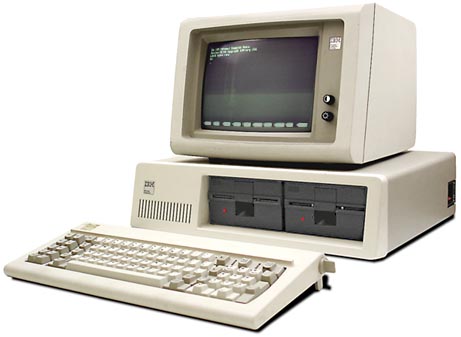
Listening to "The Continuing Story of Counter-Point", I feel this enthusiastic fear of the future. Between the counterpoint notes lies the wonder of the computer age as it was originally felt--in the mystery of the molded plastic box sitting on the desktop, the strangely mechanical and yet knuckle-popping eroticism of a 5 1/4" diskette being inserted into its drive, and in the shadowy mystique of green graphics splayed across the black mirror of a CRT screen. In those interior circuit boards, entire metropolises might very well exist, their uncanny future of dystopic speed a vision of our own, understood in fantasies of digital ghosts and disembodied electronic doppelgangers, dreams of viruses not even microns in length because their existence was in the ideal reality of information, and of sentience so new as needing to be taught to speak. A potential deux ex machina to the human race, simultaneously the prime mover of the next; these are the haunting specters not of old crimes, but of potentially apocalyptic dreams. The only thing worse than the memory of past misdeeds is the oracular-telephony--Oedipus' new technological prototype--the uncanny digital-prolapse in knowledge of the unavoidable fate of the future's cataclysmic desires.


SF felt this wonder mightily, and imbued their creations with its aesthetic of future trauma in the language of the present tense. In David Borden's oscillating score I hear the insinuated anxiety of flying above Blade Runner's Los Angeles, the diving rhythm more than compensating for the lack of visual flames, and the steady drone of Vangelis' own synth compositions radiating from the environment. In this world the advertisements are the only visible feature in the sky, and the synth warms us to the concept of new diseases, the synthetic frailty of life we are currently in the process of inventing.


I can feel it also mirroring the excitement and tremor of coming events, like in the opening subway ride of The Warriors. Barry De Vorzon's synth in this sequence is the teenage push, the libidinal id overly prevalent in these futures, because regardless of whether or not we are aging rapidly or finding eternal life, the world is constantly new to us, an uncomfortable ocean of emotional triggers we will never learn how to respond to properly, because the hormonal imbalances brought on in the desiring-milleau of the future can never resolve themselves to a millenial cosmos forever on the first-day of its unfolding. The guitar riffs may be the same, but they'll be heard looking out of the front of a high-speed subway car, looking down into the darkness of the tunnel ahead. In this future, everything will always be violently different.


Even in the misunderstandings of the technology we find the same aesthetic. Take Tron, Disney's paradigm of anthropomorphism. The humanity of computing components aside, this world is painted in glowing luminosity on its edges, but its planes are composed of the dark void. Power is rampant, though it takes the storybook guise of the evil sorcerer of old. In this current-future we live above entertainment arcades, working on designing what plays out below, even entering this circuit system ourselves. But whether the ligature of the circuit actually is the highway it resembles, we are still in the system--and isn't this the source of our anxiety, and the basis of our charge of thaumaturgy? Computers are the demons we so welcomingly invite into our homes. Journey may grab the title tunes in the soundtrack, but Wendy Carlos' synth score is the main-stream nightmare, Disney-fied.


The paranoia finds its climax in Terminator. Nothing more than a B-grade stalker/shooter on its face, we are forced into the depths of speculative fiction to think about the cyber-time'd cyborg sex roles between human and machine. Anxious, murderous death represses the orgasmic little death in this film, as red-eyed, mindless pursuit replaces our truly dangerous desires of fusion with machines. The dance club is called, "Tech-Noir", and the fashion-stagnant crowd dances to the synth beat in a despicable love of newness and consumer technology, while meanwhile the machinery underneath the flesh stalks its female victim, naturally attempting to forestall the the future fecundity of its womb. This might be the caricature, and the tag-line bringing them into the theater. But when you watch the chase scenes, seeing bullets traded between these species from the windows of the now archaically-huge detroit dinosaurs, flying under one present's Los Angeles circuit board of highway structures, molded in history's undestructibly cheap concrete that will one day form merely the rubble, like a beach of our smashed skulls, the synth takes on the aspect of pure fear, pumping from the speakers like adrenaline into our blood stream, emoting the danger and darkness of 80s LA with thermonuclear blast punctuated by a laser's harsh glare.

This is an synth-aesthetic that is now dead to us. When we view these representations of the future, they seem retroactively passe, trapped within a time-period of hairstyles, pop music, cars, and obsolete technology.

But maybe this technological-consciousness is not obsolete, but simply changed. Our technology now serves a different role, prompting us to explore nowness, rather than the future. Our technology is developed and designed to blend in, and to form a seamless element of our consumer environments. The aesthetic replaces function in many instances, rather than stemming from the function, or its future-potential function. We no longer look at disk drives as a remarkable fusion of the mechanical with the ideal. Now we design our flash drives to look like other things. We don't hunch in front of work stations, cramping our bodies around the square physicalities of glass-enclosed electron guns, relying upon our imagination to translate text into space. Everything is ergonomic, designed with clean lines and recessed flat screens, fitting in the pocket as easily as a neoprene bladder, becoming flat and light, meant to blend in with its surroundings rather than be the component center of attention. The electromagnetic consciousness has been reduced to nothing. Now we expect our machines to survive drops to the floor, and being dunked in a latte. There were days when we purged our workspaces of all electromagnetic interference, from too-large electric motors, to tiny refrigerator magnets and toys. We were conscious of fields, and their effect upon the data. Magnet data extended its importance into a presence, a scientific element of the environment, and storage material was treated with a necessary respect. Now this is outsourced to server farms, almost never touched by human hands--to the "cloud", the ancient coupling of existence without weight, bespoken of the Olympic firmament, rather than the world we inhabit. It isn't humans that have been isolated, enslaved, and reduced to their usefulness like slaves. We have enslaved the computer, and destroyed its humanity.

We have removed its life-blood, we have reduced its sense of speed. They grow faster all the time, but now in invisible ways, beyond the scope of our keeping pace with them. The speed must be measured to be understood, rather than felt through the clicking of servos and circuit diagrams. The chase is over, and the war is won. The power of information conjured from thin electricity is now about as mystical as running water, a din covered over in the background, which we can turn up our headphones to avoid. The clicking of the hard drive was the sound of a heart beating, but now a good machine is a quiet machine. Synth no longer stands out, imbuing sound with a bursting fullness of modulated frequency, but forms the back beat, made ambient by the continuing presence of fashion and character, that everpresent reality of commodified music, technology's intrusion into this field no more than a passing fad of notice, easily outsourced to samples and re-instrumented hooks.

Computers do not stand in counterpoint to humanity any longer. This surfacing current has been smoothed over, pushed back into the desiring-flow of culture, resurfaced only reshaped and appropriated, as a bit of kitch, or a example of the pace of history: a beginning point for the graph of Moore's Law. The alien quality of the digital was once its allure, but now it is a measure by which it can be placed into dead history.

Luckily, counterpoint itself seems to be a technique never fading in the human sense of aesthetics. The rebounding, echoing repetition of contrasting patterns is hardwired, we might say. The one to our zero, perhaps. Or maybe the zero to our one. It is no time at all to wait for its next instance, when the accelerating rythym swings back the other way, bathing us once again in that uncanny green glow of the free-radical of time.

Until then, we still have David Borden's music, if you can find it.

8/27/2008

What if I Told You that the Hegelianism Never Ended?

I think my last post responded to a column on Erik Davis' website Techgnosis (though originally it was published elsewhere). As I think I mentioned, I'm a big fan of his writing and his work because I haver such a confluence of interest with his topics.

For instance, this recent post that deals with Blade Runner, Slavoj Zizek, and SF literature. As potent a melange as a beet, cherve, and dandelion-green salad!

But let me add the vinegarette, if I might be so bold: Davis draws attention to the uncanny realization of the replicant in Blade Runner. He quotes Zizek, discoursing on the film:

"Let us recall how, in Blade Runner, Rachel silently starts to cry when Deckard proves to her that she is a replicant. The silent grief over the loss of her “humanity,” the infinite longing to be or to become human again, although she knows it will never happen; or, conversely, the eternal gnawing doubt over whether I am truly human or just an android—it is these very undecided, intermediate states which make me human." [Davis' emphasis]

Yes, this is indeed the post-modern aesthetic that makes such movies and stories so popular in this modern age. "I thought I/it was... but in reality, it was..." The horror, the tragedy! Our ideas explode into flame on the jagged, gothic spikes on reality. The matrix has us all, and we constantly struggle (uselessly) against its modern power that even gets into our minds, (bodies) man!

And self-described Hegelians like Zizek try to argue that it is this liminal zone, this uncanniness, that is the very reality of consciousness, or humanity. And non-self-described Hegelians do as well. (Whether they are Hegelians or not...) Most of the critical thinkers of the last century draw our attention towards some sort of liminality, some borderline, or sublime transference between two states that is used as a point of pivot for their theory. And they are not wrong to do so; this is a very new concept for theory. Many philosophies rigorously distinguish between the this/that, and totally ignore the and/or point. It is a new point on the dialectic: the point of transfer that unites the entire equation...

Or is it? I will can the rhetorics; no it is more of the same. It doesn't really matter how uncanny it is, or that it is "shaky" as opposed to the ur-ground of older philosophers. What it is really looking for, is a new point of authenticity.

Authenticity. I said it again. This is word that I use for it, harvested from the translations of Heidegger that I have read. Heidegger is a great example of this search for authenticity for several reasons. One: despite the very historically-important dualities that he disregards and deconstructs, the authentic vs. the inauthentic is a constant parallel to which he returns. Two: although he all but explicit states that there is no qualitative preference for authenticity of inauthenticity, you can read, very loudly, that he is striving for the authentic. Authentic being, authentic metaphysics, and authentic society. This last item brings us to point three: he accepted Nazism. Now, I would not put his work in the "Fascist" section of the library, nor would I say that it should be read as a causal vector towards Fascism. However, it can't be ignored that brilliant and groundbreaking as he was, he was swayed to desert his colleagues, fellow humans, and even lover in favor of the volk, with such horrific general consequences of which we are all very aware.

Oh, and lastly, "authentic" is a word that is pretty easily accessible to those who haven't read Heidegger. Which, for some reason, seems to be a category that includes almost everyone. It meaning is not so nuanced: there are different ways of doing to same thing. You can win by striving hard according to the rules, or you can win by cheating. One is authentic. Why? Because it wouldn't be a race if it didn't have a start point and an end point, and a prescribed course between the two.

Human race, Aryan race, 100-meter dash... all the same? No, of course not. But all have "authentic ways of being" what they are. This is what Humanism is. A relatively recent development, it takes a collection of moral axioms and cultural standards culled from over the last 5,000 years or so, and binds them all together in one agnostic, ill-defined package called "humanity". For example, if there is a genocide or other tragedy somewhere, you must declare outrage at the fact of suffering, but not necessarily do anything. Competition is fine, as long as there is a general belief in the "fairness" of this competition. Monogamy, for some reason, is really sweet. Love is also great, as long as you submit sacrifices of lust on the altar from time to time, because courtly love is like, way creepy. This is what it means to be human, authentically, circa 2008.

Of course, this is not a monoculture. We have plenty of counter-authenticities. Being ironic in the face of other's suffering is cool. Opting out of competition is also really chill. And generally thwarting monogamy to be "in love with lust" is really current. Especially if you post about it on your blog. You can also post about Zizek on your blog: case in point, myself.

And this is what Zizek is doing; he is defining a post-modern, self-described Hegelian, sub-Lacanian, authentic humanity. Which is: a totally un-humanity, where we are constantly disturbed that in this crazy, year-of-our-internet we don't know where the human begins and the iPhone ends. This isn't a humanity of commandments, or of morals, or that you can write about in a book. Oh, wait, Zizek has written it in a book! How many books has he sold lately?

And it is a very attractive idea to the humans who are constantly stunned by what "they" thought up next, or what's on the internet now, or what's new and different. What if we did wake up and discover we were all robots? Oh well, that's just these times that we live in. My entire reality is rewritten via Wikipedia every night, and broadcast on YouTube every morning.

No! This isn't humanity, or authentic anything! It's channel surfing; it's hyperlinking; it's trivia night at the local hipster bar! The problem is, the authenticity itself is false. It is a wild goose chase, a constant search for what is real, or even, ironically unreal, in and among these shifting sands of modern... what? Irreality? Unreality? Falsehood? Machinery?

This is what PKD is getting at in his books: you can't bet on anything to be what you think it is, not ever--whether it be robots disguised as humans, humans disguised as robots, or humans who think it is cool to be a robot. All his main characters are stumbling through worlds of bizarre, uncanny occurrences. But, these are not worlds of quick-sand reality, where the bait-and-slip is so, so post-modern. SF is always already the questioning of reality. What if we could fly to the moon? What if the Germans won WWII? These are concepts that fuck with reality. PKD's character's do not have reality because their events occur in worlds that are already twice unreal--they are fiction, and speculative fiction that is meant to be different then reality. The characters trip through worlds of sensation and harshly cut-together events, and the only reality is the sense that the phenomena creates at the moment. Any search for meaning in a more meta-sense is doomed to break itself off in a fiendish circle of double, triple, and quadruple ironies that expose the fascination with such metaphorical curiosities as the fashion circus that it is. Sometimes the characters find an ending, and sometimes they don't. There is no reality, and yet, it is as real as anything ever is, anyway. Take Man in the High Castle. This speculative concept of an alternate history: what is the conclusion? The conclusion is, this world is made up, invented by an author. Germans win, germans lose, there was a war, people die after living their lives, those who survive now live in some sort of post-war world. Of course, everything in contingent on what does happen. But what is the end result of reality? Nothing. Except itself. No historical is more authentic than another, and in fact, no reality may be more authentic. If one day we wake up to find it was all a sham, guess what? We still have to go to bed that night and wake up again the next morning. What if this town is the battle ground between chaos and order? What if I'll die tomorrow? What if I'm already dead? What if none of these statements are true? It's not nihilism. Nihilism is the constant, fleeting search for meaning that ends with us dying, having found nothing more than when we started, but only flitting from eternal truth to eternal truth, to the death of eternal truths, to the birth of tangential truths only found in gritty (and cyber-punk, if possible) liminal spaces.

The movie of Blade Runner can be interpreted either way, depending on what is important to the viewer. Is authentic humanity important to you? Then waking up as a non-human would be a huge problem, and one where you could philosophically find your real, true humanity (and sell books about it). Or is simply living important, as it seems to be to Decker? If you can't tell the difference between your authentic humanity and your replicated humanity, why worry?

"Too bad she won't live... but then again, who does?"

The Nexus-6 who dies after rambling on about C-beams glittering through space (an excellent scene, by the way) is dealing with problems of existence, not of humanity. What is it like, to die? Well, he's actually lucky because he has discovered, from the boiler-plate on his spine, that he has a maker, and can go to his address. And when he fails to put off the issue of life/death into the future for you, you can kill him, and maybe feel a little better. Most of us don't have the option, and instead we can only muse about such problems of existence in SF novels or on blogs.

But what if I woke up tomorrow, and discovered that I wasn't going to die? Well, I suppose it would be a little weird at first. I would probably have to find something else to blog about. But is my toast going to taste different without the sword of Damocles hanging over my head? Maybe, if you are a humanist and thought that this relationship between you and your end colored your entire life with meaning. Or, if you a self-described Hegelian, and your conception of reality was based upon a flip-flopping from one plateau of the dialectic to the next, given gravity by that huge authentic signifier forever floating out above your head somewhere. But if you were a realist, and understood all meaning to be as uniquely real as it is transient, then perhaps you merely grin and see if you could get a date with that hot replicant-receptionist. It's not buddhist. It's simply real. I always thought it was funny how, despite the existential, speculatively-mind-warping time-space crises that PKD's characters live through, they never seem to miss an opportunity to sleep with a woman or imbibe a mind-altering substance.

So, when that pharmacist shows up at your door with an energy beam that reminds you that the Empire Never Ended, just smile, take the bag of painkillers, and see if you can pimp it into a SF trilogy. Thanks, and goodnight.


ps. One technical note, that I thought of after finishing the post. If the replicant is truely undergoing a universally human, existential experience upon the realization that one is actually a synthetic human, rather than a wetware version, then it follows that the ability to have an existential experience such as this is actually a synthesized experience. Then it is not a "truly human" problem, and the Nexus corp. only engineered it as a truly synthetic experience. There is no way to say how a true human would respond to the discovery that they are synthetic, because a true human could never, truthfully, discover such a thing. However, the fictional tale of someone very-much-not-quite-unlike a human finding out this truth could evoke a lingering doubt in true humans, who would then philosophize on the idea despite it's purely speculative nature. And, perhaps this is the actual meaning of existentialism--the pondering of realities that are like our current reality yet outside of the reality of experience (e.g. "hell is other people", yet who has written the book about what the opposing heaven is like?). After all, part of the interest in what happens after we die is that there is no one around to give us a review. What are the limits of experience if there is no way to experience them?

But anyway, I think this conundrum brings up a much more interesting question re: Blade Runner. Why the hell did the Nexus corp. invent a machine that would have an existential experience? Was it a philosophical experiment, under which they created a machine in their own image, that had questions about life, the universe, and everything that they themselves had? Or was it a programming bug that developed while they were trying to create a machine with conscious-like artificial memories (the key being, the memories linger but fade, and can be recalled in a not-quite conscious way, giving rise to an understanding with a limited scope of consciousness, that would invariably question what lay outside such a consciousness)? Or was it more purposefully? Frankly, that's a pretty good fail safe. You're memory machine breaks down, and realizes that its a fake (in other words, that limited consciousness now sees more than it was supposed to). So, just like Windows, it phones home the fatal error! The machine travels across the solar system with no desire greater than wishing to meet its maker. Master, I have fatal exception E845FG1, (error code: theorization of the limited totality of consciousness) please fix me!

3/02/2008

Let's Build a Giant Airship!

Remember the cuddliest cyborg of the 80s?


No, not the Nexus-6!


I'm talking about the bear with a soul of standard audio tape, the creature containing enough C-battery voltage to stun a 6-year old, the often replicated, often duplicated, Teddy Ruxpin!


Note the way the children nod their heads in commanded unison.


The bear works by only having audio on one of the stereo tracks of the cassette; the other contains its evil, mouth-moving hypnosis commands in the form of buzzing pulses.


The cartoon works via a heroic dose of psilocybin injected directly into the bloodstream.


Did you manage to see the LARGE CRUCIFIX on the rear of the airship?

They made a full 65 episodes of this! And then, as I'm sure you remember, half the population of bears became self-aware and fought the other half for control of all the crystals in Grundo.


Well, actually, all the companies that ever sold it (like 4 in all) went out of business, despite the toy's popularity.


I'd really like to get a hold of one of these for use as a boom box. They don't seem too expensive (they did make a lot of them), but I really hate eBay. The modern remakes use a chip rather than cassette tape.


NEW FOR THE INTERNET AGE:

Teddy Ruxpin's Airship Child-Safe Internet Surfing Portal!


ps. Happy 100th Post to me!