Showing posts with label consumerism. Show all posts

5/12/2010

Microfiction and Product Death

I have a lot of literary balls in the air right now, so it's time to start committing a few to the Internet, to get them out of the way.

I've been thinking a lot about micro-fiction recently. At first I was against the idea of some sort of gimmicky constraint on the fiction-writing process. But then, after I tried writing a bit of micro-fiction, my perspective changed. The process by which one writes micro-fiction is different than simply writing. The space constraint means that each sentence must be packed full of meaning, taking the reader somewhere very purposefully. Adjectives are deleted, as is repetition. Sentence structure is made as minimal as possible, very efficient. You start discovering ways to hack the grammar, to say more with less. What subjects and objects can be dropped completely? When would simply a verb suffice as a sentence on its own?

A thing I always look at, in any sort of literature, is the assemblage of the writing. Sure, you've written something enjoyable of a certain length, it's a novel. But what does this novel attempt to do? Does it have a goal? Why or why not? What goals should writing have, if not just informative depiction, or entertainment? If it is less than a novel, what is it, and why? With micro-fiction, often the goal is a joke or a riddle. You let on only enough information for the reader to discover the "catch" by the time they get to the last line. Hemingway's "six word story" is one of these (and often the classic example of micro-fiction). The goal of that story is that you "get it", but only at the very end. The Joke formation is a classic trope-goal of human literature. It is like a vector model of motion: you move in one direction, and then another vector sends you in another direction. You thought you got it, but the punch line makes it mean something different, and NOW you "get it". There's nothing wrong with this; except, maybe that it is all do easy to use this as the "goal" when you have only a few words to use.

What else can micro-fiction do? What is worth saying in just a few words?

If you follow my Twitter feed, you might have noticed I have a certain preoccupation with the Consumer Product Safety Commission's product recalls. I follow their RSS feed (which is available through the link) with great interest. The interest is macabre--not quite dark, perverted, or Modernist enough to be considered Ballardian, but still there is something quite bizarre about the physical dangers of every day consumer objects. It's kind of like an infomercial coupled with a death announcement. Sharp blades, hazardous chemicals, high voltages, extreme temperatures, pinch and choke points, and deadly stored inertial energy are around us all day long, but normally sealed within lovely consumer design, like a butler with a pistol. The CPSC does fantastic work. We may think to mock the safety-conscious "nerds" who test every day products for any conceivable danger, but the days of caveat emptor have been replaced by strong protections against the profit-seekers. Most recalls come from these elaborate safety laboratories, protecting us from the danger we need never know. And yet, if you search the CPSC's public records, you will find that several product recalls a year do not occur without registered deaths and serious injury being attributed to faulty design, materials, and construction.

A consumer device--something so innocuous and common-place--can also be the symbol of any person's particular death drive. The death we seek out, and pay for, in the form of convenience and good design. Death lurks under all of our desires, the entropy at the end of the joke that is our lives.

Perhaps micro-fiction and consumer-hazard were meant to be together. The short, consumable package, the encased, enclosed, economically-packaged power--and the end result, the final toll, the end of the story. Maybe together, they can find a meaning for each other.

I'm going to write a micro-fiction story inspired by each day's worth of CPSC recalls, and publish them here (amid my other blog rambling). Not every CPSC recall is interesting, and they may not come out every day. Not every story I write will be interesting, either. But at least they will be short and easily consumable. And in some of them, we may just find the product we've been searching for. I'll continue the experiment until I recall it, or until it's made obsolete.

12/07/2009

IF(mp3=digital, createnewrecord, ctrl+A, Del)

I can't believe what a nerd I am. Look at this post I just wrote, and thought was a good idea! Can you believe the nerdy title I gave it? Wow. Anyway, posting anyway, as an example of the weird analytical stuff I actually think about during the day.

So I did this really stupid thing about a year and a half ago. While working as a karaoke DJ (this wasn’t the stupid part, okay?) I decided to copy over the external hard drive of DJ tunes to my own hard drive. I knew it wouldn’t be the best music of course, but I thought, here’s a chance to get all those classic party songs they put on those monthly mainstream DJ compilations, and well, I just never could turn down an opportunity to make my music collection more encyclopedic.

Big mistake.

Not only did I severely over-estimate the number of “classic party songs” to pure crap, I also forgot to take into account that the guy whose hard drive it was is one of the most unorganized, non-encyclopedic people I’ve ever met. My music library became clogged with unlabeled, mis-labeled, duplicate tracks, most of which I didn’t want anyway, with their titles written in all caps. To the tune of about 200 gigs.
If you are not acquainted with the true depths of my analytical neurosis, let’s just say that such a poorly organized “library” has been a heavy weight bearing on my database soul for the past year and a half.

But never fear dear reader, because I am working through. Little by little, I am making my way through the genres and deleting, re-categorizing, consolidating, stripping, and re-writing the metadata. I first did “alternative”, “punk/hardcore”, “classical”, and “jazz” so at least I could listen to some music without going crazy. I got rid of the “other” and “uncategorized” categories little by little, and eventually consolidated “hip-hop”, “hip hop/rap”, “gangsta rap”, “rap/hip-hop”, and “hip-hop/R&B”. Last night, I finally finished “pop”. The only ones left are “rock/pop” and “rock”, which are large, but by this time I am being brutal with my deletion, so I hope to finish this week. If I don’t immediately recognize the name, it goes. If they have a single song I don’t like, it goes. If they have a single song with a Christmas theme… Ctrl+A, Del.

Throughout this process, I have had much time to lament how horrible the music player programs are at sorting music. I use iTunes primarily (iPhone user). But for sorting purposes, I also tried Songbird, Media Monkey, Windows Media Player, and Winamp. They differ a little bit, but without buying extra modules, there really isn’t any improvement. The best thing one can do is to sort by a metadata category, and just brute force your way through it. Even so-called “duplicate” finders are pretty weak, with no way to qualify how close or far a supposed duplicate might match its pair. And then, they are remarkably proprietary. iTunes is notorious (at least among the people who discuss music library databases online) for not allowing the language of its library files to be touched. There are some Applescripts out there for making some changes, but amazingly, it is very hard to re-organize a music library any other way than through a browser.

Just so we’re clear, I’m talking about the music library, which is different than the actual mp3s on your hard drive. The library is basically a database file, in some derivative of XML, for organizing the track names, numbers, artwork, actual file locations, and other metadata for display through the player’s browser window. There is a re-write process between the file itself and the database (what iTunes calls “organizing”, or maybe “mediaTunes” now?) that will adjust the actual metadata of the mp3 to cohere with the library database.

Now, I know when I say this, the reason it is so is because so few people have the disposition to categorization that I have, but all the same—the databases available for media organization are abysmal. I don’t really see why—it is easy enough to add XML interpretation into a program. Your word processor can probably do it. But I guess in the effort to make media players as “cleanlined” as possible, (i.e. iPod/iTunes-like) these are abandoned in favor of tools that let the program do all the work.

And I’m not interested in trashing the iTunes mentality, because through it all, they’ve still put together an excellent media player. Sure, it’s a bit heavy for a media player program. And it has a tendency to do things “automatically” that really screw up—like losing user-uploaded artwork trying to auto-download it, and we don’t even need to get into the DRM stuff. But as basically a front end for their music store, it is still pretty damn usable for someone like me, who has only bought maybe two things from the iTunes Store ever.

For example, I love the Smart Playlists. This is the sort of functionality I’m talking about. These are basically database queries, where you can define ranges of the metadata variables like “times played” or “date last played”, and insert randomization and total record quantity. I have several personal “radio stations” made from these tools, and they work great. Of course, there is not as much flexibility as I would like. The same thing goes for the Genius function, which is basically a personalization query, based on variables iTunes doesn’t disclose. Of course, you can’t edit this, and for someone with +100 gigs of mp3s and a computer 5 years old, it kind of gums up the works. But it’s the right idea.

The thing I realized, while deleting 50+ copies of duplicate shit-club mixes of Akon’s three biggest songs of 2007, was that despite the hysteria about intellectual property insinuating that a song is infinitely replicable, and a mere collection of digital bits, we still don’t look at our music files as data. There is an aspect of the commodity in every mp3; it takes on more than what it is. An mp3, to a consumer, is purely the music experience, not the possession of data which can create the music experience. My DJ associate with bad file habits thinks to himself, I want this song in my music collection, and adds it in, with no thought of where it will go. When he wants to play the song, he searches for that particular track, and plays it. There is no browsing, no querying, no organization. The more duplicate tracks he has, with different spellings and different data in different categories, the more likely he’ll find an instance of it when he searches for it in the search bar. The entire analytical process is, Want->Get. It’s the purest sort of production/consumption there is.

This is good for record companies, who try to institute the fear that if they can’t make money, then you won’t have any more mp3s. Actually, with DRM, they’re probably right. But it isn’t true—being able to drag and drop an entire collection of mp3s proves the point. An mp3 is only data. Music has long since past the point of expressive performance, and has entered the realm of digital data, along with many other aspects of our life. Now, expressive performance, the actual production and consumption, live within the differences of binary digits.

So what are you going to do? Well, as any database administrator will tell you—stop doing that! That is, having poor data habits. We know to back up our data, and to be careful where we get our data, but now we need to learn to organize it. A well-kept database is a useful database. Only one item of data per variable, each record separate, no duplicates, proper linking conventions. Clean query programming. It’s just what makes sense.

Of course, no 13 year-old just starting their mp3 collection is going to do this. You just throw ‘em in a file as you download them. So instead of instituting my Universal Rules of Epistemological Fortitude, as I would like to do, I instead look to the media players. I want MS Access, with a media player function. I want write combo boxes for my playlists. I want SQL queries in mp3 queries. I want to add IF/THEN statements to my iPhone syncing. Maybe with some top-down redesign of software, we could start treating our mp3s as what they are—valuable data.

3/09/2009

The Birth of a Typeface

So I will begin by saying, no--I am not a trained typologist.

(You know you're in trouble now, don't ya?)

But no, I am not a trained typologist.

I only just learned the difference between a serif and a sans-serif font. (serifs!)

But regardless, I intend now to speak to you about a scourge sweeping the world or words. And that scourge is:


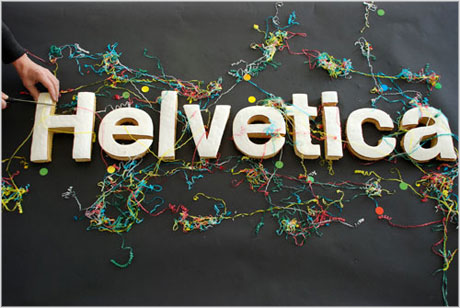
Helvetica.

I hate this font. But let me tell you why.

It isn't enough that it is used by thousands upon thousands of brand-names.


It would only be typical then, that it would be selected as the official font of such a hallmarks like Apple, infecting not only the logos, but the actual text of my email and text messages.

But that isn't enough.

It is also used OFFICIALLY, for the font of the MTA and Chicago Transit.

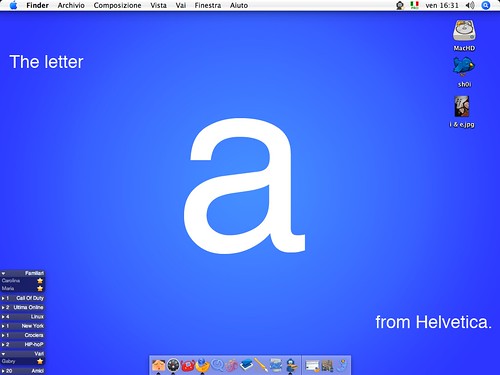
So everyday that I rode the train home in New York, I didn't just ride the 2, 3 to 135th street, I rode it to:


Consider myself branded.

This is the font of brands. It is perpetuated by brands. Unlike Arial, a very similar font that gained popularity by being a computer default in countless programs such as Microsoft Word, the only standard Helvetica has assumed is that of the brand: the clean, direct lines which design loves, the evened, paced weight, the proportional spacing, and the lack of any sort of hand-writing appearing calligraphy styling.

It is cold, proportional, and machinic. It is totally modern. It is simple. Different. Apple.

You see? I didn't even mean to do that, but I slipped into design-brain-fuck-land, just by thinking in Helvetica! I dreamed that the entire world was proportional, and my interface was entirely clean and smooth, and every person wore black jeans and black mock-turtle necks. Most importantly, we all only spoke in informative slogans, and nothing was wasted. All of us sans-serif enuchs were perfectly happy, because we had been designed to be so. No third-party OS, no viruses, no pulse. Simply: Bliss.


I don't mean to pick on Apple, but they are certainly one of the most-recognizable users of Helvetica, and for the same reason that they design products with slim form factors: it is recognizable and clean, and sticks in the mind like an icepick covered in wall-paper glue.

But enough of this effluviac outbursts at the users of a mere font. Perhaps I should talk more about the font itself.

It was designed in 1957 by the Swiss--at the height of the fame of Swiss design and graphic arts.

According to Wikipedia, a goal of the typeface was: " to create a neutral typeface that had great clarity, had no intrinsic meaning in its form."

This is pure modernism in its most commercial state: form is function, right? No form other than the meaning it intends to transmit. It is pure, unassuming, and liquid. A bright, shining, blue-eyed Jesus of fonts. A white dove. Concrete. White plastic.

But isn't this a form in itself? A metaphysical attempt to reach the design-centric esoteric knowledge of pure performance... it is a product so useful we cannot help but buy at least one or two. Give them as gifts. Decorate with them. They are objet-de-arte, a paper-clip so beautiful we buy them just to place on the desk. We put them in museums, because we admire something so useful. In fact, we would never dare scratch it surface with actual use--that is to say for a font, actual content--because it would dirty the purity of the form which we so admire: no form at all.

This is sounding familiar. A form so ideal as to take on the qualities of form itself... an object so perfectly useful as to defy any actual use... a commercial unit that defines the goals of commercialism perfectly.

A Commodity.

Leave it to the Swiss to turn phonemes into commodities of exchange. Leave it to the Americans to buy into a commodity with everything they've got, putting the whole corporation on the back of its cleanly designed weight.

I won't push the comparison too far; I respect the philosophy behind exchange commodities too much to act as if Helvetica actually has bearing on the linguistic economy as great as the monetary system.

But at the same time, the similarity is uncanny--and deliciously so. The idea that a typeface could be designed without form! As if it was pure transaction of linguistic value! As if there was no aesthetic surplus value added by the appropriation of a certain type by so many major corporations and institutions; as if they were not telling us something with this form; as if the casting of logos into typographical symbols was not itself a massive trick of design! Which is more recognizable: the Apple logo, or the word "iPod" written in Helvetica? You might recognize the apple, but you are forced to read "iPod" over and over again by the mere naturalness of written communication. By developing a non-destracting design which feeds into the eye's sense of proportional weight, they are almost forcing us to speak their product name outloud, every time we use our eyes.

Well, maybe it is not as drastic as all that, but if you believe in any fundamental principles of aesthetics and design, it isn't too far off.

What they've done is developed a brand for modern commercialism, a brand for branding, and the representative product of brand is Helvetica: the type without form, and only function. No goal but the propagation of product. No exchange but more exchange. No value except that for which it can be exchanged.

John Carpenter should have definitely used Helvetica for the font of the brainwashing signs in They Live. His font is a little too 1940s, a little too bold. Perhaps he was thinking of Fascism more than the commercialism of the post-war period.

Far be it from me to call Helvetica a fascist font--or even a capitalistic font at that. It's only a damn typeface.

But, I think the link between its intended design, its use, and its subsequent popularity are quite interesting. Helvetica will be a signpost of our times. It is a symbol of late Capitalism, by way of being a symbolic type par excellance. And as such, it is ugly, and dispicable. It is the metaphysical grapheme of consumerism, and I hope it dies along with it.


...but then again there is this:

"Helvetica is a relatively contemporary typeface, protected by Trademark owned by Linotype, that was designed in 1957 by Max Miedinger for the Haas Type Foundry in Switzerland. However, there existed an earlier typeface that was designed and put into use by Joseph Goebbels for the German Socialist Party and it is Goebbels' type design that is regarded as being the forerunner of what was later the derivative typeface (re)designed by Miedinger and named as Helvetica.

There have been a few books written about Helvetica recently from contemporary perspectives and although well written, they revise the history involved. Reading a few, I see an effort to both apologize for a past creative work effort and to deny that it occured and for contemporary, political reasons. However, in Literary Theory, there is an understanding of arts apart from troublesome political pasts, creative works as now having been "cleansed" in the conceptual and theoretical and thereby considered on their creative merits without association with offensive political characteristics. Helvetica is a work of art that has been "cleansed" in this regard and it is a disservice to try to rewrite the history of the art involved out of fear for the climate in which the art was created; and, using the art or making reference to it does not thereby imply nor make reference to the now-removed, offensive originating circumstances -- not in the case of this typeface nor in the case of other, similarly considered creative works."

Ahh! Fascist fonts!