Showing posts with label Apple. Show all posts

5/16/2010

Interface Me With Speed Please

So, with the ongoing obvious caveat that any sort of blogging on gadgets or technology is probably a waste of your time and no doubt conceitedly wrong-headed if not erroneous on its face...

I've been thinking some more about portable computing interfaces. Nerd alert.

SO, basically, the deal is that I am, like, really excited for the Chrome OS. The more I use Chrome as a browser, the more I realize how superior it is to other browsers simply for that RUSH of SPEED like gunning a V8 on a stretch of western highway, that even the smallest hint of acceleration in this velocity-twisted information economy is like a drug after a couple days of being off the stuff. And accordingly, I'm using more and more web apps. Google Docs? Loads and saves faster than a text editor. Gmail? FUCK Outlook. Never again. Switching between seven windows, fifteen tabs, faster than opening a new Windows Explorer window? Put it all online. I don't care. I'll do anything for that RAW, that FAST, that DATA-RUSH interface high that is instant micro-multi-tasking.

So, the iPad. The future of computing, maybe? According to the media? According to people who like shiny things? I had a new idea about this.

The iPad is the bridge. Many gripes about the possibility of Chrome OS sucking involve the potential lack of native applications. I have no idea if this is true or not, but, let's look at the iPhone OS.

Of the 50 apps I have on my iPhone, 30 of them would have no function if not connected to the network. Of the other 20, 12 are straight-up games, and then 5 more are basically "entertainment related" (a simple program without the need to save much data or interface with other apps). There are 3 stand-alone apps on my iPhone that I have downloaded, that improve the function of my mini-computer without an Internet connection.

Now, if Apple let you really alter the structure of their mini-computers, I might have some more utilities, some need to save data to the device itself. But they have already made it, for almost all intents and purposes, a Network-OS. And we've learned to love it. In fact, our use of the internet as an interface has shifted to take advantage of this relatively light-weight OS, utilizing networks rather than storage space, the cloud rather than OS, html and scripting rather than registry and resources.

Now for the second big part of the iPhone OS: multi-touch. Also, changed our interface to data. I find it absolutely incomprehensible that I can hand an e-coupon pulled up on my iPhone screen to any store clerk in America, and they will pinch and flick as naturally as if they were opening a paper envelope. Have an iPhone? Look at the way you turn the pages of a book. It's a little different now, isn't it?

This was what spurned this thought: this week I was talking to an IT tech in my work's new building. He was using a Fujitsu tablet PC, running Windows 7. So he says, this is the only tablet PC on the market that is multi-touch capable. He had bumped it up with 8gigs of RAM, SSD, etc (though bear in mind that in all these anecdotal examples I'm about to give, its really the SSD making the difference). He showed it to me--pretty slick. Boots from cold in less than 10 seconds. Loads programs as fast as you can click (literally, I watched him do it). Scrolls Microsoft's Earth mapping program, pinch, flick, all that, beautifully. Not like "other" multi-touch phones, that don't quite have that iPhone zip, but exactly the same.

Now the interesting part, is that he says it is best on Microsoft programs. Why? Because Microsoft has designed Windows 7 for multi-touch. I asked him what other companies have multi-touch capable software. No one. Because this is the only tablet PC with multi-touch (I think HP has that media wide-screen desktop thing, don't they? That's a custom, light-weight OS though, I think). He said he uses Explorer as a browser (I know, right?) because it's so seamless. Because it is designed for the interface. Everything else just acts like his finger is a mouse.

So, what I realized is not that any particular OS is going to be the next-new-whatever, but that I continue to see evidence in furtherance of the thesis that it is not any particular functionality that is really driving the usefulness of technology, but the seamlessness of the interface. The seamlessness is the SPEED by which we can interface our data. The quick response of the steering wheel that makes us think we are driving a high performance sports car, even if we are not. We want to feel the pull of the acceleration on our loins, see the speeding white lines of our data as we open and close it at will, flicking it around the roadway. The deep, psychical pull of the modern obsession with speed and acceleration is too deep rooted for us to be post-speed. Control is just too sexy.

iPhone OS taught us to love speed again. It taught us that as long as we're moving fast, we're interfacing our data better. And for the most part, this seems to be correct.

Now, if the Chrome browser is any indication, Chrome OS could be our flying car. We're okay with interfacing all data to the network. We'll adapt for the speed of it. I have no idea if Chrome OS is going to be multi-touch capable or not, but I can tell you that I'm sure developing multi-touch for a OS based on a browser is a lot easier than for Windows 7 and all Microsoft software. Firefox has multi-touch. Does the Chrome browser? I forgot to ask my new IT friend. But how much of a leap will that be?

And you know what the Chrome OS will definitely have that the iPhone OS will not? Moveable walls. It's going to be open-source, or at least open-enough that you can run say, a light-weight Ubuntu partition for all your old-school, mouse-click native apps and games, hard-save data, and private-private-private stuff, and then Chrome OS for your network interface. My IT friend had a couple virtual OS's on his souped-up Fujitsu. Know how long it took him to boot a virtual XP OS? Less than a second. Ubuntu? Less than that.

iPhone OS has made a lot, a lot of money off of its closed nature, because it pulled ahead. It was the innovator, and as such, was showered with gold. But apart from a high-design drink coaster, what is it they are really introducing? Something that they cannot hold by themselves forever. It's only a matter of time before someone else can replicate it, and they will replicate it open-source (whether its Google or not, simply to highlight their competition with Apple) and it will be cheap and fast and easy and will go onto any netbook you can slap a multi-touch screen on. People will buy Apple, because Apple makes very nice coasters. But their lock on the interface can't continue for ever. Nobody can restrain the human impulse for interface speed.

So, as sure as I can be without it actually existing yet, I'm super primed to buy a multi-touch mini tablet as soon as Chrome OS is actually an actually thing.

Next week: back to your regularly scheduled predictions and condemnations about the death of god, the re-birth of sex, anti-capitalist economics, and drug-addled anarchistic metaphysics.

1/29/2010

iGet It

Ok, I get it now.

I already wrote my last post on why tablet computers will be near-useless devices, though they may sell. [summation: it's the input device, stupid!]

So I won't wade backward into that.

But I get it now. I get the deal with the iPad. It will sell of course, not as well as the iPhone, which was a revolutionary device. It will sell for a while, and then eventually be replaced by something that does the same job.

You see, I underestimated Apple. The one thing that you can be sure of is that they didn't just pull this idea out of their ass. They've been selling high-priced digital commodities for a while now, and they know how to test a product. They know how to design something that people will buy. The failure of analysts and tech commentators (and me, though I'm not either of those) is to think that Apple is a company that designs computers. No. They design products.

Some articles have made comparisons to the iPod as not being an actual innovative product. Nothing new really, except a new shape, and limited feature glut. True. But the big hole filled by the iPod was filled by iTunes.

Back in those days, most people either used Winamp or Windows Media Player to play their unorganized mp3s they scored, mislabeled, off of Napster and its latter day siblings. Both of these are a bit unwieldy, especially for someone who doesn't really know what an mp3 is, other than a music file.

Then comes iTunes. Clean white space, easy to see buttons, and no annoying things like "bitrate" that anyone has to "understand". It connects directly to you mp3 player, which has an identical look and feel, exactly and every time. Furthermore, you can download organized, clean mp3s through the same program. $.99 was a pittance to pay for such ease of use. And this brings us the Apple we know today.

This is all the App Store has done. It's made navigating programs and features on a smart phone as easy as buying an mp3.

And the iPad is just taking it a step further, to "computing". I put computing in quotes, because as anyone who really knows a computer knows, the iPad is not really computing.

And this is Apple's genius. Because I would estimate, off the top of my head, that 75% of computer users do not know how to use a computer.

This week at work, I watched a co-worker almost buy a new computer because a pre-installed Dell program kept crashing. I watched people unable to sign on to webmail for hours try sending faxes instead. I watched my boss try and save the contents of his old computer, which was "ruined" by a broken power plug, try and back up his media files, only to say "fuck it" when he couldn't easily move his Adobe software, because he had lost the product key. I watched a co-worker who actually knows how to use Macs very well screw up his forehead in frustration when I tried to explain to him that drive partitions were not just a "Windows thing".

It's 2010 here, people. Or as I like to call it in such instances, TwenTen.

In the year TwenTen, isn't it time you stopped being embarrassed by nerdy kids who can set up POP forwarding? Shouldn't there be some product you can buy that doesn't get that damn "Facebook virus" every time you have thirty-three browser windows open? Why haven't "they" designed a computer that's not "so goddamned stupid" that it has so-called "file format problems"? In this year of personal computing, I would pay, like, $1000 for something that doesn't suck.

The iPad's innovation is that it's made the entire PC part of the UI. It's thin. There's nothing behind it. There's nothing behind the curtain... just the curtain.

The iPad is the cheaply bound, pasteboard hardcover book of computers. Sure, it's made well, I bet. But it's going to be bought by people who leave their computers on planes, let their kids smear MacDonalds grease into them, and who drop them while trying to find their car keys. It's going to be bought by people who typically render EVEN USER-FRIENDLY MACS useless within a year and a half.

The iPad is the OLPC for the middle-class american adult.

Frankly, it's about time. It's about time we cut these suckers loose. It's funny that computers are trending in the extreme user-friendly direction about the same time as I'm learning Linux prompts. There's a rift opening up, and it's time we cut the cord.

Don't get me wrong. I like helping people who can't use their computers. I don't even make money off of it. But being the go-to guy to fix the email or the database or the printer makes me feel good, and I can teach people a thing or two in the process. But after the sixth time resetting the router, and the tenth time stopping someone from paying $50 an hour to have some stranger break their hard drive, I'm starting to think there are certain people who just need something they can use. You can't follow people around forever, waiting to catch their grape juice as it tumbles towards their keyboard. Maybe it's time we gave these people a glowing, scratch-resistant screen, and let them curl up on the couch to play Internet.

And it doesn't seem a bad device for that. Hey, if all I wanted to do was go online and watch video, then maybe I'd get one. But strangely, I'm one of those people that actually uses a computer for all kinds of complicated stuff. Internet, music, games--my cell phone does that crap. If I'm getting a good processor and large screen, I'm organizing text files. I'm archiving data. I'm piloting efficient networks for my friends and family. I'm harvesting the Internet for usable information, cataloging, and making available to myself for re-use. I'm syncing my life throughout all my devices, not just one pretty one. I'm restoring and recycling old computer pieces, building computing appliances to run my stereo, my alarm clock, my hydroponic garden, and whatever else. I'm learning about how computers work, and experimenting, and trying cutting edge software and information technology. And I'm fixing other people's electronic things when they break. For all of those things, I need an actual computer.

So maybe there is a new device here. There is an Internet portal, designed for everyone who only needs the Internet, but has no use for a computer. And maybe the devious part is, this will let computers function on computing, and portals do the porting.

3/09/2009

The Birth of a Typeface

So I will begin by saying, no--I am not a trained typologist.

(You know you're in trouble now, don't ya?)

But no, I am not a trained typologist.

I only just learned the difference between a serif and a sans-serif font. (serifs!)

But regardless, I intend now to speak to you about a scourge sweeping the world or words. And that scourge is:


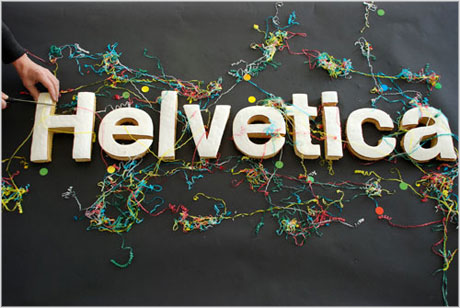
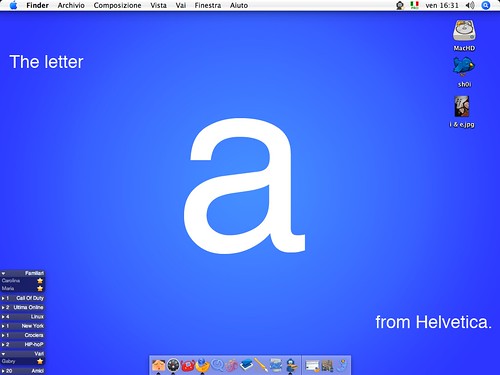
Helvetica.

I hate this font. But let me tell you why.

It isn't enough that it is used by thousands upon thousands of brand-names.


It would only be typical then, that it would be selected as the official font of such a hallmarks like Apple, infecting not only the logos, but the actual text of my email and text messages.

But that isn't enough.

It is also used OFFICIALLY, for the font of the MTA and Chicago Transit.

So everyday that I rode the train home in New York, I didn't just ride the 2, 3 to 135th street, I rode it to:


Consider myself branded.

This is the font of brands. It is perpetuated by brands. Unlike Arial, a very similar font that gained popularity by being a computer default in countless programs such as Microsoft Word, the only standard Helvetica has assumed is that of the brand: the clean, direct lines which design loves, the evened, paced weight, the proportional spacing, and the lack of any sort of hand-writing appearing calligraphy styling.

It is cold, proportional, and machinic. It is totally modern. It is simple. Different. Apple.

You see? I didn't even mean to do that, but I slipped into design-brain-fuck-land, just by thinking in Helvetica! I dreamed that the entire world was proportional, and my interface was entirely clean and smooth, and every person wore black jeans and black mock-turtle necks. Most importantly, we all only spoke in informative slogans, and nothing was wasted. All of us sans-serif enuchs were perfectly happy, because we had been designed to be so. No third-party OS, no viruses, no pulse. Simply: Bliss.


I don't mean to pick on Apple, but they are certainly one of the most-recognizable users of Helvetica, and for the same reason that they design products with slim form factors: it is recognizable and clean, and sticks in the mind like an icepick covered in wall-paper glue.

But enough of this effluviac outbursts at the users of a mere font. Perhaps I should talk more about the font itself.

It was designed in 1957 by the Swiss--at the height of the fame of Swiss design and graphic arts.

According to Wikipedia, a goal of the typeface was: " to create a neutral typeface that had great clarity, had no intrinsic meaning in its form."

This is pure modernism in its most commercial state: form is function, right? No form other than the meaning it intends to transmit. It is pure, unassuming, and liquid. A bright, shining, blue-eyed Jesus of fonts. A white dove. Concrete. White plastic.

But isn't this a form in itself? A metaphysical attempt to reach the design-centric esoteric knowledge of pure performance... it is a product so useful we cannot help but buy at least one or two. Give them as gifts. Decorate with them. They are objet-de-arte, a paper-clip so beautiful we buy them just to place on the desk. We put them in museums, because we admire something so useful. In fact, we would never dare scratch it surface with actual use--that is to say for a font, actual content--because it would dirty the purity of the form which we so admire: no form at all.

This is sounding familiar. A form so ideal as to take on the qualities of form itself... an object so perfectly useful as to defy any actual use... a commercial unit that defines the goals of commercialism perfectly.

A Commodity.

Leave it to the Swiss to turn phonemes into commodities of exchange. Leave it to the Americans to buy into a commodity with everything they've got, putting the whole corporation on the back of its cleanly designed weight.

I won't push the comparison too far; I respect the philosophy behind exchange commodities too much to act as if Helvetica actually has bearing on the linguistic economy as great as the monetary system.

But at the same time, the similarity is uncanny--and deliciously so. The idea that a typeface could be designed without form! As if it was pure transaction of linguistic value! As if there was no aesthetic surplus value added by the appropriation of a certain type by so many major corporations and institutions; as if they were not telling us something with this form; as if the casting of logos into typographical symbols was not itself a massive trick of design! Which is more recognizable: the Apple logo, or the word "iPod" written in Helvetica? You might recognize the apple, but you are forced to read "iPod" over and over again by the mere naturalness of written communication. By developing a non-destracting design which feeds into the eye's sense of proportional weight, they are almost forcing us to speak their product name outloud, every time we use our eyes.

Well, maybe it is not as drastic as all that, but if you believe in any fundamental principles of aesthetics and design, it isn't too far off.

What they've done is developed a brand for modern commercialism, a brand for branding, and the representative product of brand is Helvetica: the type without form, and only function. No goal but the propagation of product. No exchange but more exchange. No value except that for which it can be exchanged.

John Carpenter should have definitely used Helvetica for the font of the brainwashing signs in They Live. His font is a little too 1940s, a little too bold. Perhaps he was thinking of Fascism more than the commercialism of the post-war period.

Far be it from me to call Helvetica a fascist font--or even a capitalistic font at that. It's only a damn typeface.

But, I think the link between its intended design, its use, and its subsequent popularity are quite interesting. Helvetica will be a signpost of our times. It is a symbol of late Capitalism, by way of being a symbolic type par excellance. And as such, it is ugly, and dispicable. It is the metaphysical grapheme of consumerism, and I hope it dies along with it.


...but then again there is this:

"Helvetica is a relatively contemporary typeface, protected by Trademark owned by Linotype, that was designed in 1957 by Max Miedinger for the Haas Type Foundry in Switzerland. However, there existed an earlier typeface that was designed and put into use by Joseph Goebbels for the German Socialist Party and it is Goebbels' type design that is regarded as being the forerunner of what was later the derivative typeface (re)designed by Miedinger and named as Helvetica.

There have been a few books written about Helvetica recently from contemporary perspectives and although well written, they revise the history involved. Reading a few, I see an effort to both apologize for a past creative work effort and to deny that it occured and for contemporary, political reasons. However, in Literary Theory, there is an understanding of arts apart from troublesome political pasts, creative works as now having been "cleansed" in the conceptual and theoretical and thereby considered on their creative merits without association with offensive political characteristics. Helvetica is a work of art that has been "cleansed" in this regard and it is a disservice to try to rewrite the history of the art involved out of fear for the climate in which the art was created; and, using the art or making reference to it does not thereby imply nor make reference to the now-removed, offensive originating circumstances -- not in the case of this typeface nor in the case of other, similarly considered creative works."

Ahh! Fascist fonts!

10/06/2008

You Can Take That Panic to the BANK!

As I try and digest the most recent government hoodwink, in the form of the Emergency Economy Stabilization Act, several news articles have caught my eye. I could just ruminate about them to myself while sitting in the closet sipping whiskey from a jar, but I promised myself only to do that once a month. Instead, I'll share them with you!

I'll get right to the point: we done been Patriot-Act-ed. Yes, I know; my posts on this topic of late have been turning up the vitriol even higher than my normal 50% by volume cut off level. You may think that this post is shaping up to be just another rant. Let me assure you: while it does fill me with rage, I do have some actual facts in tow to back such assertions.

Check it out: terrorists (supported by the government?) kill people -> nation quakes in fear while legislation consolidating the nation's autocratic power sails through Congress. Happy Department of Homeland Security to you, the Department of Peace vulture born from the ashes of the Immigration and Naturalization Service (not a coincidence, but that's another story).

Now re-check: bankers (supported by government) screw over people trying to buy houses -> markets quake in fear while legislation consolidating the nation's capitalistic power sail through Congress. Our current door prize is the Office of Financial Stability, attached to the Treasury. You have to love that name. It doesn't quite say, "propping up our failing economic system" in the same way that "The Strong-Arm of Capitialism League" would, or the way a dilapidated FEMA trailer does. but OFS is good enough. It also lends itself to the great anti-globalization/capitalism slogan, "Fuck OFS!" My copyright certificate is in the mail.

Doubt it was fear that motivated? Well, seeing "777" written on the front page of my local paper makes it pretty clear what the average person was supposed to take away. But let's not trust an average person, let's ask a congress-person!

From the New York Times: "Fears about the economy also motivated support. 'Nobody in East Tennessee hates the fact more than me that I am going to vote yes today after voting no on Monday,' Representative Zach Wamp, a Republican, said. 'Monday I cast a blue-collar vote for the American people,' he continued. 'Today I am going to cast a red, white and blue-collar vote with my hand over my heart for this country, because things are really bad and we don’t have any choice.'" Well, Representative Wamp, you've made it pretty clear. Instead of voting in the name of your constituents, you decided to vote with your Jingoistic shirt on. Good on you.

One day, the bill is opposed because the constituents demand it. The next, it passes. Apart from a few tacked on incentives, the only thing that changes is the Dow dives by a number that is only 3 digits away from 666. What changed? They added the FEAR.

But after all, FEAR is the market. Capital is the universal unit of the irrational mob. Don't get me wrong, the mob is sometimes good. All understood signifiers derive their meaning from the linked desire of multiple individuals; linked desire is the mob. But this also means that it can get out of control. And once you link these mob-signifiers to things with actual material significance, like, say, mortgage-backed securities, a simple scream can mean that the government has a new bureaucratic entity run by good-old boys from Goldman Sachs. Or, so it seems.

Hey, and check this out too. You want to see mob-signifiers move a market? I found this story on Slashdot: it appears that a web crawling Google engine accidentally reprinted an old article from 2002, when United Airlines was just about bankrupt. Investors, thinking it was a current article, dumped the stock, which declined to $3 a share from $14, evaporating 1.14 billion in market cap. BECAUSE OF GOOGLE! Ahhhhhhhhh! That's okay, people pass laws in such ways these days. Soon enough, Google will be fact, so that won't be a mistake, it will be reality.

It happened again! Some jerk on CNN's newsTwitter thing posted that Steve Jobs had a heart attack, which he totally didn't. Too late! Apple's stock dived 9%. Now they blame this on the stupid citizen journalists who try to be real journalists, posting lies on their stupid blogs. Stupid blogs!

But wait, real journalists are just as stupid! Take the case of Gary Weiss, the BusinessWeek journalist who, it has been pretty conclusively proven, rigged Wikipedia to spread disinformation about selling "naked short" stocks, a strange market derivative that has been blamed for the current crisis almost as heavily as mortgage-backed securities. This disinformation was not accidental, but postively malicious, though the motive still remains unclear. "Real" journalists trusted Wikipedia, and blackballed CEO Partick Byrne, who was trying to warn marketeers about the dangers of the "naked short" phenomenon. Total cost: unknown. $700 billion dollars anyone?

So, what the deal? Well, it appears that is incredibly easy to manipulate large numbers of Americans and their representative leaders via the equity markets and the information markets. Effect: so-called "value" evaporates, leaving someone holding the tab. And even worse: government, as is typical in the case of panic, responds with authoritarianism, bureaucracy, and worse, which history always proves is worse for you and me.

'Adam, are you arguing that panic leads to Fascism?' Well, I would hardly be the first. But it's funny that you should ask. Apparently some one suggested to US Representative Brad Sherman that if the House did not vote for authoritarian bureaucracy as a delightful middle ground, the next step would be the end of Posse Commitus. I.E. You would have soldiers enforcing local "law and order".


Just a little something to think about. Sounds kind of familar, doesn't it? Say, about seven years ago? You, me, the president, congress, the end of civil liberties, the legalization of torture, and an ongoing, useless war?

Oh, the Dow dropped another 370 points today. Maybe its time to write your congressperson.