
In
the last post I read regarding racism/bigotry, I wrote about the difference between racists and bigots; the former run the systematically racist institutions of the country, under the perhaps believed pretense that the institutions are fair, because they have the support of the majority population. The majority opinion, however, is often largely composed of bigots, who actually have a believe that some class of people is better/worse than another (although maybe only unconsciously), and so allow--either positively or through lack of action--the racists to continue operating racist institutions under the auspices of "fairness".
I think that this conception of the problem is hard for many "critically-minded observers" to grasp, because we look at the problem of racism/bigotry as a singular issue, one of "hate vs. love", or "democracy vs. intolerance", whereas the difference between a person having some hatred within them is very different than the substantive and systematic problems that allow for material persecution to arise. In other words, in most (but not nearly all) places in America, a person can walk down the street in relative freedom without being harassed and threaten with bodily harm, but this does not mean that there are not systematic reasons why more "minority members" of society are in poverty, or incarcerated, or in other words put at a material disadvantage to the material benefit of others.

So, in yet "other words" again, many avowedly liberal elements take an altogether simplified critical view of a problem that they claim to be facing, and therefore do not help solve the problem, and instead, perhaps are complacent. "Democratic" ideals will not provide the "A.N.S.W.E.R." to racism, because it is through "democracy" that racist systems such as our immigration policy is "elected" by our nation of bigots. As I try to remind people often, and they just as often like to forget or shrug off as an fluke of history, many regimes of outright hatred, oppression, and bigotry (can I scream 1933 any louder?) have been democratically elected.
Anyway, this is all a recap, and a further emphasis. The real reason for this post was that I happened to come across a neat little articulation of this sort of dynamic between the "higher" culture element of racism and the "lower" element of bigotry. Often they work in concert, such as in an out-and-out fascist regime, where the leaders exploit the hatreds of the people in order to catapult their policies. I would theme anti-immigration politicians in this country under this category.
However, another sort is perhaps just as malignant while appearing to be helping to fight bigotry. This is the liberal attitude of which I gestured towards; in which bigotry perhaps is critically engaged, but with the favor being towards an ideal "liberal" society in which the values of democracy are identified as being counter to bigotry, when in fact, they allow it to roam free, and perhaps to gain power. The systematic racism may roam free, divorced by liberal democratic theory from the bigotry that is so obviously abhorrent.
Enter, if you please, Herman Melville. The man may have had certain prejudices; I cannot say, as I never had contact with a mid-19th century man, nor Melville himself. But I have had contact with some of his writing, such as Chapter 26, from his novel
The Confidence-Man. The title of the chapter in this de-light-ful book is as follows:
Containing the metaphysics of Indian-hating, according to the view of one evidently not so prepossessed as Rousseau in favor of savages.The chapter is an account of a backwoodsman who hates Indians; apparently not an uncommon character in Melville's day. The narrating character tells us about these persons:
"The backwoodsman is a lonely man. He is a thoughtful man. He is man strong and unsophisticated. Impulsive, he is what some might call unprincipled. At any rate, he is self-willed; being one who less hearkens to what others may say about things, than looks for himself, to see what are things themselves. If in straits, there are few to help; he must depend upon himself; he must continually look to himself. Hence self-reliance, to the degree of standing by his own judgment, though it stand alone."
This is not too far afield from most bigots; having little education or "social" rearing, they rely upon their own feelings in their politics as they have had to in their lives, and thus are given to the maxims of popular opinion rather than the ideals of learned society. A reliance upon one's own abilities may lead to a false sense of superiority. And even what he learns is often skewed:
"For however charitable it may be to view Indians as members of the Society of Friends, yet to affirm them such to one ignorant of Indians, whose lonely path lies a long way through their lands, this, in the event, might prove not only injudicious but cruel. At least something of this kind would seem the maxim upon which backwoods' education is based. ... 'As the twig is bent the tree's inclined.'"
A strong-willed, not-quite-supremely educated person is often a bigot. This seems plausible. But the most interesting part of Melville's chapter, to me, is the title. Although it isn't mentioned in the chapter itself, this backwoodsman is contrasted in subtle fashion to "one prepossessed as Rousseau in favor of savages".
Of the bigot/backwoodsman: "Suns and seasons fleet; the tiger-lily blows and falls; babes are born and leap in their mothers' arms; but, the Indian-ahter is good as gone to his long home, and "Terror" is his epitaph." However, the person who is enamored with the idea of the "noble savage", on the contrary, is a fickle creature--the vicissitudes of whose so-called steady, critically-reasoning gaze are subject to shift with the currents of popular theory. Is the concept of the "noble savage", a theory that intends to posit a pre-Fall (or perhaps pre-
felix culpa) innocence of man, really the logical and theoretical opposite to bigotry? Is loving through false equality the fix to hating via false superiority?
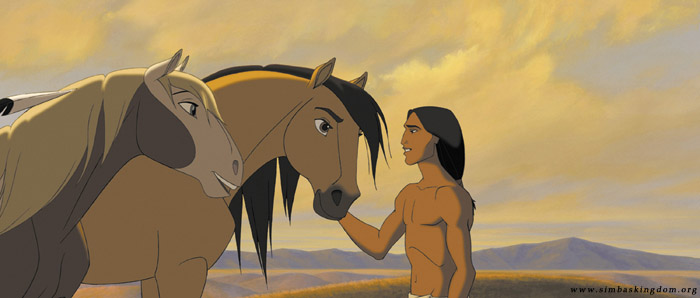
Now, we can look back upon Rousseau's theory as a merry occasion in our history of colonialism, when those silly Europeans thought that the funny-colored people they were killing might have been a transference of their own misplaced innocence. Thank goodness for the Christ! If it wasn't for redeemers, we might have to actually deal with our issues in this life.
But is the humanism of today really any different? Or have we simply shifted our colonialism to within "us", letting the vegetables on the bottom of the melting pot burn and stick to the bottom, as long as the top is heated comfortably? Those of democratic theory try to convince us that only if everyone is equal, then hate will magically disappear as a relic of the dirty world before the "son of man" that is equality saved us all. As long as equality is resurrected in the Millennial future, we can say that it has merely died for our sins, and not for our taste for blood. By attempting to find the "soul" of humanity as an equal and innocent equivalent within us, those of the "noble human" philosophy neglect to deal with the hatred that is our actual existence. The fact is, this is not just an optimism; it is an avoidance of the reasons that people hate. How will nostalgia for the "noble savage" stop the Indian-hater from stalking his prey?
It really isn't so complicated. One only has to see what the problem is: the Indian-hater still exists. As long as he exists, he will conduct his war:
"Ever on the noiseless trail; cool, collected, patient; less seen than felt; snuffling, smelling--a Leather-stocking Nemesis."
Until, that is, we actually have a chance to inscribe that epitaph for him. And frankly, that isn't the responsibility of any noble savage.
 This dog was collecting tickets outside of the Agora.
 These cats were in the Acropolis.
 This baby goat was foraging in the hills outside of Nemea.
 The famous, "kitties of Delphi", who were very interested in this man's halibut.
 An Olympian lizard.
 Chickens outside the hotel window. There was also a turkey, but I didn't take his picture.
 Kitty and gyros- 4 euro.
 A cat on Santorini on stairs
 Tortoise. I also saw two makin' little tortoises, but for their privacy I did not take a picture.
 This is my aunt's dog, and so not really Greek (actually, Chinese by birth) but she is certifiably cute! And, her name is Zoe, which is Greek.


