Showing posts with label Markets. Show all posts

5/21/2010

The Natural Algorithm Hustle

Here is/was my contribution to 48HR Magazine. They did not publish it, though it seemed as if they had some interest. Perhaps because I couldn't reveal my friend's identity, who I met in grad school, it seemed a bit dicey. Anyway, here it is.


My contact is an algorithmic programmer at an wealth management firm in downtown Chicago, the firm managing somewhere in the neighborhood of seven billion dollars. I spoke to him via email, this morning. He was in the "hole", as he called it, as he is most of the time. His name and company are withheld, to keep from violating his non-disclosure agreements. I'll call him Al.

Adam: Tell us where you are right now.

Al: I'm in a small room, approximately ten feet by twenty. There are no windows. It's lit by several lamps. Pretty nicely furnished. Big flat screen TV, comfortable chairs. I'm at a long desk, with five computer monitors. Most of the rest of the space is taken up by the server racks. The room is fairly cold, what with the climate control. We call it the hole, because after spending twelve hours or more in it and coming out, the light can be, well, shocking.

Adam: What is it that you do there?

Al: I design the algorithms that control our trading programs, and watch them function. In other firms, I'm known as a "quant", or a "cruncher". We run our algorithms differently than many firms though; rather than simply doing quantitative analysis of trading markets, we guide our trades by a method we call "fractal market distribution".

Adam: What is fractal market distribution?

Al: Exactly what it says. We distribute our market interests according to fractals.

Adam: Like the well-known patterns, Mandlebrot and Julia sets?

Al: Not those algorithms, but it is essentially the same. Those well-known fractals are graphs of particular algorithms on an imaginary number axis, and zooming in on a particular area. We aren't making a visual pattern, but governing our trading behavior according to the described dimensions of an algorithm.

Adam: How does this differ from the algorithmic trading most firms do?

Al: Most firms take the movement of the markets as the dimensions which their algorithms seek to describe. They analyze the quantitative data of the market in the attempt to predict the market, or at least make trades that make sense according to the data of the market. Our algorithms don't come from quantitative analysis, at least originally. Though of course, we have to find a place of correlation between our algorithms and the market in order to design the trades.

Adam: What do you base your algorithms on, if not market data?

Al: Pretty much any sort of naturally-described motion. Anything that can have data collected on it. Thermodynamics. Virus replication. Quantum physics. The weather patterns. Auto traffic models.

Adam: You make trades based on the weather?

Al: Well, it sounds that way, but not really. Any of these natural phenomena can be described, though not perfectly, with algorithmic modeling. I work with a guy at Cal Tech who specializes in these sorts of complex mathematical models. I take these models that he defines, and then interpret them, finding how they correlate to market data. They aren't microcosms of the market--but generalized patterns of natural motion tend to have corrolaries in other parts of the natural world. Hurricanes don't match market crashes, but pressure shifts on a certain day might be similar to currency fluctuations. The skill is in finding what to apply the algorithm to, and to have the fortitude to see the experiment through.

Adam: And it is successful?

Al: Largely, yes. We tend to do consistently 35% over any particular market in which we do business. This Thursday, we earned 15% on the market crash. In one day. We were using an algorithm based and inspired by bee movement.

Adam: You're referring to Thursday, May 6th, when the Dow had the biggest intraday loss in history, losing over 1000 points before rebounding. You say you made 15% on a single day? Using bees?

Al: Bees are a social entity. Their motion, both in their hives and in their environment, are based upon what are basically social cues, in an insect society. Any sort of panic is a social phenomenon. By studying one, which is easily mappable, you can make conjectures on another. We had an algorithm in place, and it paid off. The computer bought low, and sold higher.

Adam: There is speculation that computer algorithms caused the crash. But you made money on it. Is this moral? Illegal?

Al: Well, I don't know about the morality of it. But most traders use algorithms based on data they've collected, and judgments they've made. They're using math, but their math is still a function of their larger social pattern as human beings. By looking at their algorithms as part of the data, we map them as well. We can guess what their algorithms will do, and when they might pull the plug. Then we can benefit.

Adam: So is this legal?

Al: It's not illegal. The SEC is investigating algorithmic trading, supposedly. But it's just another way of making a decision. Whether it's flipping a coin, or using a multi-processor computer, it's just another tool to make a trade. Maybe they'll try and limit the speed of the trading, to keep it from snowballing. But there is so much money, and so many trades, a panic, or glitch, or whatever you want to call it is impossible to avoid entirely. It's a market. It's a system, and that's how the system works.

Adam: How did you discover this method? Just sitting in front of the computer, trying things until it worked?

Al: The Cal Tech professor and I were working on a project with robots.

Adam: Okay, robots? How are robots related?

Al: There were a bunch of autonomous insect-like robots, programmed to get to the highest point of a terrain. They learned to climb onto each other, to get higher up. They were physically designed to be able to climb each other, but they were not preprogrammed to do so. The key to the programming was that they were not forced to hurry as fast as possible, or they would tumble off of each other as they each tried to climb. Their time axis was extended, so as long as at some point during the experiment, they reached the highest part of the room, they would be considered to have succeeded their programming. They waiting for the opportunity, basically taking turns, and did much better than they would have done if they moved all at the same time.
We figured we were the robots--rather than try and force the our market strategy to succeed at once, we extend our T axis, and keep our various algorithms going. At some point, the opportunity for a natural motion pattern to succeed will make itself available. We don't need to worry about the odds of a crash, or the odds of a sudden sky-rocket. Capital shifts like the robots, and time is irrelevant. We just need to wait with our algorithms, until we can get a leg up, and then we can climb to the top.

Adam: You realize this sounds like a crazy, sci-fi hippie scheme?

Al: Well, we don't really go into a room of quants, mathematicians, drug users, sci-fi authors, or anyone else, and claim to understand the fabric of the universe. We don't. We just found a system, and stick with it, that seems to work. Other people have other systems, and they work. Investment groups hire tons of skilled traders, and that system works for them. This is our system.

Adam: So what other algorithms are you working on?

Al: I'm excited about one based on data collected from Google News. The way interest builds on certain topics, and they become "media headlines", so to speak. The ratios at which they collect, and at what levels they spike, we've found to be significant. We're also been looking into how oil spreads on water, studying data from the BP oil spill. The interaction of large masses of two homogenous, yet different fluids is very interesting. We've also been looking at sex.

Adam: Tell us more about sex.
Al: Watching how singles of various standardized rated levels of attractiveness, among a particular sub-culture, interact over the course of a night at a bar. The conversations, the pairings, and who leaves with whom. If you quantify it, basically you get a hierarchical choice tree. If you rate attractiveness on a level of one to ten, you have a base-ten selection algorithm.

Adam: So you expect people to believe you pretty much make money off Google News?

Al: We don't make money off the news--we make money of the fact of the social existence of news. The same "fact" of people publishing and reading and linking to news is the same fact of buying and selling on the market. That's what makes us money. The market isn't a free market, a state market, an investment market, or any of that. It's just a market--a series of relationships. People buy and sell things as part of society, and what we do is just the mathematical extension. You don't have to believe anything anymore, but regardless of what you do, people will make decisions, and either succeed, or not.

Adam: Anything algorithms based on Twitter?

Al: We tried to model Twitter Trends and re-tweets via the API firehose, but the data just wasn't very interesting. Mostly second-order algorithms. The key is finding something that is complicated enough that it makes a pattern that isn't inherently obvious. Then, you can match it to market data, and find things that improve upon just straight guessing, or market models.

Adam: Any plans for the future with this theory? Or just keep at it?

Al: I'll just keep making money, I guess. It's too bad that we put so much capital into, basically, a mathematics exercise. We can't really apply this to anything else. You can get 35% over market with trading, but what's the point of getting 35% over, say, human movement at a rock concert, or 35% over random chemical reactions? There's only a payoff for beating randomness in the financial markets.

5/13/2010

Micro-payment Feudalism

I'm about to propose that micro-payments are a system of capitalist exploitation, the scope and potential of which have not been seen since the days of feudalism.

Ready? Go.

The myth of micro-payments is that the little guy can make money off of what was free, by charging only a small amount for it. Because these payments are in the digital arena, there are basically no raw materials costs, and therefore any payment whatsoever is pure profit.

This is the dream of capitalism: a reduction of labor costs to zero, so that any amount charged is complete surplus value. A money making machine.

But what this forgets is the system of distribution. The system of distribution is fundamental to a market--in fact, it is the oft forgotten twin sibling of production. You cannot sell anything you produce unless it gets to those willing to pay, and so any value of your product is as dependent upon distribution as production.

The market of the Internet is of a feudal land market.

With land as the only material form of wealth, those with land will consolidate their land, using their land to increase the value of their land. In a feudal society, the land is the resource from which anyone lives. Of course, a square mile of land can support more than the people who live on it (i.e. relatively few users per mile) so an ownership class can develop, who are not working the land, but simply owning and coordinating it, providing limited access to their serfs in exchange for the surplus produce.

This changed with the industrial revolution, when a working class could be established that would further the owner-class' capital (value now dissociated from the land) by being paid, as long as profits were still collected. When value was pulled away from the land, and became "materials" or "labor" or "market share", capitalism was invented, because anyone could profit anywhere, as long as they found a way to charge a markup. Anyone could profit, except those working with their hands, of course.

Now that raw materials (at least in terms of media) are becoming valueless, and workers are in oversupply, we're moving back towards that feudalism. If raw materials for media still cost anything, some of that value might trickle back to the workers who are actually making it. But as it is, media is all over the place, and only distributors can make any money off of it. The consolidation of media is taking the place of land ownership, and the micro-payment is the deflationary liquidity by which it is valued. People might pay for some media, but the media with any actual value is the media that is circled tightly around already valuable media. Those with the ability to consolidate many micro-payments are actually making money, while the vast majority of people are working for pennies digging around in the mud compared to those with the distribution networks under their control.

Just because someone can flip you a nickel for doing your media dance does not mean that they aren't going to flip most of their nickels to the naked-on-demand-HD-video-constantly-updated-dance-network. I think there is a belief that because micro-payments are "micro", they will somehow spin straw into gold for the little guy. If anything, by INCREASING the value of money at smaller increments (making these sums liquid to those who can collect on the large scale) they will hurt people trading on small scales, because their fewer transactions will earn them less money. If a penny was all of a sudden the value of a $1 mil., you wouldn't be rich by reaching into the "take a penny" bin. The convenience store would be rich for having 17 cents just sitting on their counter that someone gave them for nothing. It's a type of transactional deflation. Think of it: YouTube starts charging a penny a video watch. At roughly a billion views a day, they make $10 mil. a day. Now, you try charging a dollar per view for your own video. You might have made $10 a day from your 10 video views, except that all those viewers are now going to YouTube for a 99% discount. If you charge the same as YouTube, you are clearing 10 cents, while YouTube is making 10 mil. You might as well make nothing. Micro-payments support capitalists, because it makes consolidation profitable.

We're led to believe that because ANYONE can collect micro-payments, ANYONE can collect a lot of micro-payments. But there is no evidence to support this belief. It is the dream of a minor merchant, hoping to be a lord.

Say you are a photographer, or a writer, or a musician. You produce your media and put it online. You put up a micro-payment system. Maybe you collect enough to keep doing it, to pay for hosting and tech fees. Maybe you even make a bit more, and have enough left over to micro-pay tips to your friends who are doing the same thing. You're basically operating at a digital barter-economy level.

But then, you hit it big. BoingBoing drops your link, the constant unfolding of which is driving they're own "micro-payment" of ad payments per view. Your micropayments sky-rocket. You have surplus wealth. What do you do with it? Distribute it to your friends? Or start your own podcast? Hire some staff writers for your blog? Set up digital-franchises?

Next thing you know, you're being bought out by Gawker Media. You're an editor now, a curator of content. You siphon your friends' media through your big micro-payment mainstream-blog farm, telling yourself its okay you're not paying them, because they each are getting trickle-down micro-payments from your powerful link distribution system. You make or break entertainers, using them to feed the network of links, each one generating a fraction of a cent, with you at the hub. You are the landlord now. How does it feel? Drink the milkshake. Drink it up.

The micro-payment theory of the Internet combines this feudalistic consolidation with a Manifest Destiny view of the infinite characteristic of markets. We could all achieve payment, and make a living, if there were an infinite amount of media consumers, with an infinite amount of nickels to give us. There are a lot of consumers, but they are not infinite. This is a gold rush, a New World. Most of us homesteaders are just going to end up moving back to the city, and working in the factory. None of us are going to strike it rich with micro-payments. The only people who will, will be those in control of the distribution. The big mine owners. Those who can set up the shipping companies. Those selling us the tickets to California. But while the cost of media's raw materials has evaporated, the influx of capital is the same as it ever was. The market is still a market, no matter how small.

So what do micro-payments do for you? Nothing, except re-orient the market so that your work is less valuable, and that those who are already making money can make more. But then again, to some people who are underwater on their mortgages, signing a share-cropping agreement with the bank might seem like a good deal. Or moving back in with mom and dad. Or, you know, like crawling back into the womb.

But, creative media has an advantage over capital. Creativity does not require investment to exist. The economies of entertainment, literature consumption, and media production do not strictly need cash investment--they need mental, attention investment. This is another marketplace that has a different sort of power. There are those who would horde attention as well--but luckily, the human's capacity to supply attention well over-fulfills the demand, and so the consolidation of attention is not as strong as the consolidation of capital. The demand for capital seems pretty near limitless. Maybe by playing this market over the capitalist markets that tend towards exploitation of distribution, we can organize. Attention is the seed of organization, after all--the same process, but different market. Someone is going to control the productive market--will it be those who can consolidate the capital, or those who can organize the attention?

Take away:

A) the myth of micro-payments lie in the idea that they improve market standing for the little guy by increasing "free" to "pure profit" in the digital arena.

B) this is a myth, because micro-payments actually constitute market deflation by consolidating value around pre-existing value mechanisms of distribution and market control.

C) micro-payments, in a void of other material costs (that might trickle back to the actual producers), represent a new feudalism by making cumulative value in distribution the only source of value, and thereby awarding real value only to those who already control value.

D) We're tempted, as always, to participate in the game by a distortion of the way the market actually works, and accordingly, the promise of advance from the bottom up.

E) The good news is that digital media doesn't need capital at all. And attention might be a trumping market.

1/15/2009

Designer Theory for Designers

Today Bruce Sterling linked to an article on his blog by Bruce and Stephanie M. Tharp about the "Four Fields of Industrial Design". (The article is here; Bruce's original post is here.)

The article is pretty simple: basically, they feel that discussion of design and design itself is complicated by the fact that it has trouble defining its intention. In order to melt this complication, they devise a rubric of the four fields of industrial design, as such:

Commercial Design (design intended to turn a marketable product)

Responsible Design (design motivated by altruistic concern for a typically un-marketable group)

Experimental Design (design that pushes the limits, trying unconventional methods and motivations for 'pure research', for lack of better term)

Discursive Design (design meant to "communicate", much as one expects the more confrontational forms of art to do)

They conceded that most projects will overlap, but these general categories will hold. That's all pretty straight-forward and reasonable. The purpose is that:

"understanding the design landscape through these four, simple categories—Commercial Design, Responsible Design, Experimental Design, and Discursive Design—will help the profession, our "consumers," and ourselves better understand design activity and ultimately its potential in an increasingly complex world of ideas and objects."

And they enumerate how in more detail than I will.

But it got me thinking (as I often do): why don't we look at writing this way?

Well, for starters, the four categories are all based upon the intention of the work. Writers, while certainly taking their own intentions into account when considering their work (wait, what?) also have other factors in mind. I think there is much more concern for the "Craft" itself.

One might argue that the Craft falls under experimental or discursive, the two artier of the categories. Which it does, but also it does not. Both the experimental and the discursive intentions of design view their work reflexively, in terms of what it does to/for other people. Some writing could be taken this way, especially writing that does break some sort of barrier or cross some sort of line. For example, any work of fiction that was the subject of an obscenity trial could be said to be both experimental and discursive, pushing the boundaries of what is acceptable and the definition of artistic literature by questioning current discursive definitions. But what about someone who simply writes in the style of Burroughs or Ginsberg, now that both texts are recognized as valuable contribution to literature? That really can't be said to be experimental, and its discursive value would not be much different than the discursive value of any other piece of writing.

Most writers, I believe, would choose to write in a particular style because it is what is appropriate for the work, and stimulates them to write it as such. Far be it from me to argue that writing has any intrinsic qualities or essential characteristics to itself--writing is nothing without a writer and a reader. In this way, intention, as a force from outside the writing itself, is an axis that pins the three together: writer, writing, and reader (even if the reader and the writer are the same person). So intention plays a role, but the relationships between intention and these three planetoids are more complex that an analysis of the post-design market as relates to the product. The realm of ideas, conversation, and morals are negotiated markets just as much as the world of consumer electronic sales, and hence, simple "intention" falls a bit short in description. Why does a product do well? Simply because it was intended to do so? Or why does it stimulate conversation, or push the envelope? Even in the non-commercial markets, currency, exchange value, and commodity have various, complicated roles to play outside of simple intention--you don't need me to tell you that. So there are many different markets interacting, adjusting values and the status of objects, in a densely complicated web that pretty much defies anyone's intention.

But are these end, consumer markets the only thing that defines the creation of the product? Any designer could tell you there is much more to it that that. Many factors go into the design and production of an object; from cost of raw materials, to equipment needed, to durability of the design in shipping. Most of these, in times such as these, are monetary based--but they don't have to be. Ergonomics is a selling point both on the product end and on the worker end--because I guess it turns out that safety is more affordable than accidents in the long term. But what about other things like enjoyment of the task for the worker, or harmonious installation of the factory in its neighborhood? Are these foolish notions, or interesting design problems?

For the writer, they certainly aren't foolish notions. While it is not necessary for a writer to enjoy what he writes, I can assure you that the writing will be much higher quality (by any measure) if s/he does. There was once a fancy term for all these design problems in production, called "means of production". For a lot of people, it is still an important concept, no matter what you call it.

So what have I proved? That writing is not intention-oriented, or that it is? The relations of production, whether or writing or manufacture, are certainly symbolic, physiological, and capitalist markets of their own, and rightly so. So perhaps it is that our intentional scope must only be broadened: intention not only extends from the designer through the product to the consumer, but must extend in a web in all directions, from the designer to the product, to the worker, to the factory, to the city, to the transit system, to the sewer system, to copper piping, and back again to toilet design.

But I think I was right originally: there is a lot more to writing (and design) than even the most complicated "intentions" can encompass. Intention, after all, is merely what we discover after the fact. Why did you use that drill as a hammer? Oh, I intended to save time. No, you were lazy--because if you had though about it, then you would have easily come to understand that using an expensive, electric tool as a blunt force object would break it, wasting lots more than just the time to get up and get the hammer. Or a better example--why did you sell bad mortgages? Because you intended to help people into homes. Bullshit: you were greedy, and didn't care whether the person filling out the application was a family, a developer with no capital, or a con-artist. And even saying that is giving you too much of the benefit of the intentional doubt--greedy wasn't what you felt at the time, it was simply what we call your actions afterward. The strange machinations that make design, or any other procedure succeed or fail only later can be labelled as "good intention". To return to design as an example, the iPhone is only an example of good design after the fact, because it made a lot of money. If it had not, then it would have been bad design. The list of things that should have many money but didn't is as long as the list of things that shouldn't make money but do.

In the actual process of writing, and I imagine, in any other creative endeavor, there is a moment where production clicks, both in the hands and in the mind. This is about as far from intention as we could get. An author doesn't intend a verb to signify action, anymore than he intends to write the next great American novel (well...) because it is only in doing so that a verb is a verb, as it is only after the novel is finished that it could be considered within history. Symbols, like objects and people, do not intend anything, they simply do things in relation to other things. This is no more intrinsic than it is intentional--the fact of meaning is, as the philosophers might say, "relative," and by this I mean relatively meaningless. The fact that meaning occurs is, for all intents and purposes (no pun intended) miraculous. By this I mean as good as un-caused, and also as important as an act of god. The reasons behind it are theological in scope, and while arguable, certainly not directly relevant in their real importance. Just to be clear: I don't mean that the meaning of words comes from another dimension or streaming in heavenly rays from the firmament, or otherwise spontaneously bursting into existence. If god turned Lot's wife into a pillar of salt, he must have done it somehow, but I doubt that Lot or Lot's wife gives a good goddamn how he did it.

Back to the point: despite the unconscious, miraculous machinations behind words (ah... hint, hint!) the author, in lining them up one word after the other across the page, is working with them as unintentional fragments, using his own consciousness and intention like a needle to sew them together. This is a little sharp bit of an axis, but hardly one piercing them altogether. There are many more important factors to the author (and likely his audience as well), such as things as esoteric as plot, voice, and characters. Of course, we intend all of this to be "good", so that the writing is "good". And we intend them to do various things amongst themselves, organizing little markets of our own in the text. But knowing this and intending it is hardly a lesson on how to write well, is it?

Can you teach creativity? Can you make a rubric of the different categories of creativity? Can you intend creativity? There are lots of other things you can do, but I don't think any of these work. Creativity is, in a way, the opposite of intention, and its partner. You may intend something going into production, or afterward, say that you had such an intention. You might do the same with creativity--hoping for it in the future, and attributing it to actions in the past. But the difference is that at the very moment of production, in the act of producing, creativity may occur, where as intention never will. You might realize creativity when it hits, or not until afterward. Maybe you will eventually deny it, though others laud you for it. But when words flow out of the mind to the hand, creativity is the force that guides them, and this is where intention can simply not go. Intention can aim and pull the trigger, but creativity is the bullet that will or will not hit the target. Because, in actuality, it is the target as well.

So in the end, I suppose my point is this: the authors of that article are absolutely right. By thinking and discussing the role of intention in design (or anything else for that matter) the practitioners and users thereof will likely benefit by guiding their practice and recognizing their own potential. However, we all wish and intend lots of things--I hope that this thinking and discussing doesn't end there.

But maybe after reading this, you will wish that it did!

11/14/2008

Let's All Be Banks!

Update to yesterday's post:

It appears that Philadelphia, Phoenix, and Atlanta have written to Sec. Paulson, requesting funds from TARP to support pension plans, and other things.

If these cities are allowed to "convert into banks", then we are proceeding down the course of the nationalization I mapped out. First banks and insurers, large financial entities, are incorporated into the "single balance sheet", then industry (GM), then municipalities. Market and Industrial Zone-Entities (MIZE, consider it coined!). Leaders of the entities are allowed to retain control, but all monetary liquidity, assets, and debt are flowed through the Fed system.

Of course, they won't let those cities become banks. Instead, they just say, "nope, just wipe out the pensions, but keep building highways." Fair enough, I guess. This isn't the Soviet Union, after all!

But more to the point, it doesn't matter that they won't get TARP funds. The Fed is becoming the single market, whether they like it or not. But, can they handle that role....

10/21/2008

How much for that fetish in the window?

UPDATE: I added a section. I thought about it more after I posted and decided some thoughts weren't quite complete.

Mental image of the week: classicist Charlie Campbell scrutinizing an ancient document on a late-night desk by candlelight; upon reaching a particular passage, he wags his bearded face and utters a disgusted commentary: "these ideological presumptions are repulsive!"

But seriously- his recent blog post on prostitution and art (sexy, sexy!) covers some interesting ground. The question: is it wrong to use a sexual relationship to further one's artistic endeavors? I was first struck by his argument in that he begins by making the equivalence of ideological and sexual purity, at least when it comes negation: to sell sex is like selling out a cause. (The true equivalence of the Left!) It seems at first that he is drawing a connection between economics of body (sex is a fair, willing exchange) and purity of purpose (art should not cater to exchanges, but represent a fair pursuit of truth). Not that this is an undesired view point; it is a nice counter from the typical liberal view that sex as an exchange is a violation of truth prima facie. In other words, in his first view prostitution or sex is not immoral, it simply should be separated from ideological/aesthetic process.

But then he continues, to say that this is not always true, which is quite valid, I think. Purity of truth is clearly as much of a fallacy as purity of body and morality. You conclude that "transcendent aesthetic meritocracy does not, and will never exist," and I agree.

I might push it further though, and say that Trotsky's point about aesthetic value "not being reducible to class-struggle," (in Mssr. Campell's words; I do not know of Trotsky's own words) is somewhat misleading--it seems to take an easy out along the lines of Marxian super-structure. That is, to parenthesize aesthetics as some kind of sideline structure; so don't worry about that little exo-structure, focus on the structure (class relations).

On the contrary, I think a certain material analysis of art might show something interesting. To cut to the chase: it's all sexual, isn't it? The aesthetic desire to view a particular piece is not much different from sexual desire. From where do our fetishes derive? A complicated question, but not very different than the question of the source of our aesthetics (and how sexy the response is depends on who you're asking).

These pathways of desire, then, that distribute art and make it desirable for owning or viewing (a sexy metaphor, that), are not much different than the strange pathways of human relations. If the way that artists and patrons sleep around (paid or not) don't resemble the vicissitudes of popular taste, I don't know what would. Is art any more than a representation of desire? Is the art world anything other than a club for sluts? Or any other so-called "humanity"? Writers, scholars, and even ideologists co-mingle their fluids almost as much as their work (and the evil twin of sex, prudery, often rears its head in these venues as well). Did you hear that Cass Sunstein and Samantha Power are hooking up?

So if you can live with my little pet theory--humanities = the pursuits of humans = the sordid lives of sex addicts--then there is only one point left to ponder. The other unfortunate truth of being human: the daily necessities of food, clothing, shelter, wine, and admission to the hippest parties. In other words, good old Darwinian success, of which artists are known for being holes to.

But, let us not forget... well, um, Claude Levi-Strauss. Structures of kinship, etc. I won't delve into it here. Did you know that in five weeks Levi-Strauss will be one-hundred years old? Amazing!

The point: that humans form bonds, often sexual bonds, to help support each others search for human necessity. Not very complicated. Artists do the same thing. In fact, if you want to talk about sacrificing oneself for art, the best place to look is at some of the spouses of our more eccentric artists. Is this wrong? Probably, in some ways. But so is marriage itself, especially when it is utilized as indentured servitude. But sometimes it is not. I don't want to say I'm a model to be followed, but take my marriage for example. My wife's job earns a lot more money than mine, and she gets good health care. (It is my opinion that any one who is anti-labor union has never known how wonderful it is to actually be in a union.) So, because she cares about my well being, we had our relationship blessed by the State so that I could also have adequate and affordable health care. In addition, we have also discussed our artistic pursuits. At some point, each of us is willing to support the other with our day jobs so that the other can pursue art (my writing, and her painting). This is really no bigger than the daily agreements that make up our kinship system: I cook, she does laundry, rent is split down the middle, etc.

So what is the sexual world of art if not a much more complicated, largely unspoken, anarchic kinship system? Rarely, rarely is it the fetishized, one blow-job = one painting hung on a gallery wall. As Charlie noted in some of his examples, it is much more complicated. Artists have relationships with patrons, and then they move on to other artists and different patrons. The choice of whom-with-whom is often bizarre, often judged to be unwarranted, and feelings are hurt. But who can say it is prostitution? I send an author $15 if I wish to own a copy of his/her book and I feel the work is deserving. I might take an interesting artist out to dinner in exchange for the pleasure of his/her company and conversation. If my interest in someone's work has sexual components, why wouldn't I sleep that person? I can say honestly, if I thought a person was not creative, my attraction to them would diminish. I think my wife's art is wonderful, and it is part of the whole of my attraction to her. It doesn't mean we exchange sex for art, company for short stories, and home-cooked meals for clean laundry, but then again, we do sort of exchange these things. Or if you ask Levi-Strauss, we definitely do.

I think the problem, as with most problems regarding value, occurs under commodification. Prostitution is the epitome of the commodification of sex. The sex is reduced to a menu of acts, and the price is firmly set in exchangeable counters. Now, this is not the problem itself; the problem is that when these securitized acts are commodified, it is much easier for oppression to occur. Perhaps the giver of the act has to agree to a price that s/he did not set; perhaps the act includes violence or power relations that would not ordinarily be securitized with the act under desired circumstances; or perhaps there is a capitalist involved who takes profit merely for packaging and marketing these securities. My metaphor here is not in topical jest; I think this is the problem. The problem with commodities from Marx's perspective: surplus value. What are you paying that you are not compensated for? In general prostitution, sometimes it is as simply as your parent's morality. Sometimes it is as dire as your bodily integrity and personal safety.

Art very rarely has these dire consequences; I have never heard of an artist being beaten for his/her art and left to die, infected on purpose with an incurable, deadly disease. I think it is disrespectful to sex workers to make the comparison.

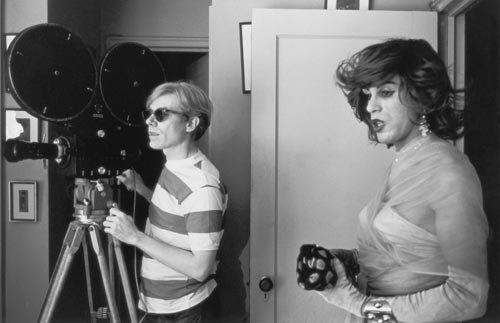
But, to return to the subject at hand, I think that the point of contention for sex and art is not that certain exchanges occur; the point is that commodity of desire into packaged securities can give and take surplus value where it is not due. It can be capitalized. Warhol, for instance, was able to create the impression of value in his mass-produced art, where I think it was not warranted. There was a certain sexiness built in to his work via his persona, which was not only not due, in my opinion, but perhaps was accumulated at the expense of those working in the Factory (the metaphor here, is simply not a metaphor). Did the unseen, anonymous "production assistants" receive any compensation for the notoriety Warhol achieved with Blow Job?

Of course, commodification exists in varying degrees in a market that, as a point of pride, claims to despise commodification. And, as I stress over and over, I do not believe that commodification is simply alienating abstraction (nor do I believe that Marx intended commodity to be thought of in this way, despite what others may think about him). But, it is true that when something as esoteric as human desire, and its partner, value, are compartmentalized into objective units, they make themselves available to capitalization, just as an open-minded, nubile artist's assistant is party to suggestion. I joke, but that is the power of the commodity of words: to imply, to suggest, to connote, and to willingly arouse.

I think one of the biggest complaints about the combination of the art-world and sex lives comes from the point of view of fairness. If one is sleeping with a gallery owner, one has an avenue to submit art to be considered that one not sleeping with the owner does not. This is a valid complain, but at the same time, it also comes from an egalitarian, democratic perspective. The supposed conclusion to be drawn from the complain is that everyone should be considered equally. Hence, blind submissions processes. There is an episode occurring in the writing world now about this very concept; it seems that certain renowned poetry and fiction prizes are actually insider popularity contests.

But then again, so what? Art is, nearly by definition, subjective. At least any superlative qualifier is subjective. And doesn't the gallery owner have to right to choose which art is hung in his/her gallery? Why not? Of course, if one gallery develops a reputation for only hanging the art of the particular tartlet that the owner is currently housing, then that is only fair.

I think that art "communities" or circles are definite popularity clubs anyhow. It's all pop these days. I might mention my wife's art on my blog, but if I wish to be known for having a fair opinion, then I would include one of those cute little "full disclosure" notes stating, 'yes, this artist and I have had our relationship blessed by the State.' Or if I wish to showcase my friends, then I could do so, but if somebody didn't like "The Interdome Set", then I could be sure that s/he would start a blog to talk shit about me. In fact, this behavior is encouraged: it's called "networking". And a network is only a social market, that (most of the time) doesn't have anything to do with sex (as much as anything can have nothing to do with sex).

And this--the commodification, and the social relations--is what we call the market, or the "Structures of Kinship", or the relations and means of production, or the scene, or anything else. Fairness, purity, and higher notions of truth upon which the work or product or relations are based, are largely bullshit, or only utilized to fool someone into doing something.

And this exegesis on markets? What is it designed to do? What is my secret objective in entering the marketplace? Well, to entertain perhaps (fat chance!), or to spell it out so that maybe one's negotiations within such a market aren't confused and befuddled in the currents and eddies. Because of course, theory is itself an art. It can be produced, commodified, and utilized to align one's reasoning in various ways and purposes. Is it true? Not necessarily, not unless it works. Right now this theory has taken up some space on this blog, and maybe occupied some of your day, if you've read all the way to the bottom. Maybe it will illuminate the human markets a bit; mostly, I hope that it just doesn't do any harm. But perhaps this is disingenuous; I do hope that it would make those who complain in the harshest of tones about how they are not "getting any" in the art/literary/culture world to maybe think twice before opening their mouths. If there is one thing I can't stand, it is people complaining about their lack of sex life: obliquely via their other inadequacies, or directly.

I can promise one thing: this blog post is in no way designed to convince anybody to sleep with me. Purity of intent by way of boring diatribe! Success!

10/14/2008

Spake, Spoke, Sprake

I'm reading Nietzsche's Zarathustra right now. It's not a perfect piece, but it is very lovely in many respects. As a critic of a certain source of modernism, he often gets labeled as one of the fathers of post-modernism, or at the very least, lumped in among other such characters. (The actual father of the term as it is now used, in my opinion, is Lyotard, but, like so many things, this is another story for another post). I tend to think of Nietzsche as the first humanist; though certainly others may also fit the term. Let's call it the ideal humanist then, if for no other reason than that the liberal democratic persuasions of current humanists would most likely make Frederich puke.

I tend to disagree with Nietzsche, as much as I admire the ire and, often, pure rage that is his writing. I find humanism and individualism repugnant in our time; though in the author's time it most likely would have been a welcome and revolutionary concept. (And, even in this day, I would no doubt find other unrelated admirable qualities in anyone who could honor one's own will as much as Nietzsche offers that one should.) I am reading the work currently for a project of my own that will deal with Zarathustra himself: the founder of Mazdahism (otherwise known as Zoroastrianism). More on that later.

Today I want to post this aphorism because despite its place within Nietzsche's humanistic project, it is still a lovely piece of work on Value, a fallacious concept that was very easily adopted by the individualism that Nietzsche helped bring into the world. Value is important, especially semiotic values; but this does not extend to such strict and powerful compartmentalization such as commodities. The notion of the awesome power of the individual aside, we could still learn a thing or two about such "poison flies". Especially in such a market as this one--a subject of some of my recent posts.

So without further ado, here is Book One, Chapter 12 from
Also Sprake Zarathustra. I am retyping the Thomas Common translation from Wikisource, mostly because it is free, and in ebook form (how I'm currently consuming it). The work is in the public domain.

The Flies in the Market-Place

Flee, my friend, into your solitude! I see you deafened with the noise of the great men, and stung all over with the stings of the little ones.

Forest and rock know how to be silent with you. Be like the tree which you love, the broad-branched one--silently and attentively it overhangs the sea.

Where solitude ends, there begins the market-place; and where the market-place begins, there begins also the noise of the great actors, and the buzzing of the poison-flies.

In the world even the best things are worthless without those who make a sideshow of them: these showmen, the people call great men.

Little do the people understand what is great--that is to say, the creator. But they have a taste for all showmen and actors of great things.

Around the creators of new values revolves the world:--invisibly it revolves. But around the actors revolve the people and the glory: such is the course of things.

The actor has spirit, but little conscience of the spirit. He always believes in that with which he most strongly inspires belief - in himself!

Tomorrow he has a new belief, and the day after, one still newer. Like the people, he has quick perceptions and fickle moods.

To defeat--that means for him: to prove. To drive to frenzy--that means for him: to convince. And blood is to him the best of all arguments. A truth which glides only into refined ears, he calls falsehood and nothing. He believe only in gods that make a big noise in the world!

Full of clattering fools is the market-place, and the people glory in their great men! These are for them the masters of the hour. But the hour presses them; so they press you. And also from you they want Yes or No. Alas! Would you set your chair between Pro and Con?

Do not be jealous of those unyielding and impatient men, you lover of truth! Never yet did truth cling to the arm of the unyielding.

On account of those abrupt ones, return into your security: only in the market-place is one assailed by Yes? or No?

Slow is the experience of all deep fountains: long have they to wait until they know what has fallen into their depths.

Far away from the market-place and from fame happens all that is great: far away from the market-place and from fame have always dwelt the creators of new values.

Flee, my friend, into your solitude: I see you stung all over by the poisonous flies. Flee to where a rough, strong breeze blows!

Flee into your solitude! You have lived to closely to the small and the pitiful. Flee from their invisible vengeance! For you they have nothing but vengeance.

No longer raise your arm against them! They are innumerable, and it is not your task to shoo flies.
Innumerable are the small and pitiful ones; and rain-drops and weeds have been the ruin of many a proud structure.

You are not stone; but already have you become hollow from many drops.

I see you exhausted by poisonous flies; I see you bleeding and torn at a hundred spots; and your pride refuses even to be angry.

They would have blood from you in all innocence; blood is what bloodles souls crave--and therefore they sting in all innocence.

But you, profound one, you suffer too profoundly even from small wounds; and before you have healed, the same poison-worm crawls over your hand.

You are too proud to kill these gluttons. But take care lest it be your fate to suffer all their poisonous injustice!

They buzz around you also with their praise: obtrusiveness is their praise. They want to be close to your skin and your blood.

They flatter you, as one flatters a God or devil; they whimper before you, as before a God or devil; what does it come to! They are flatterers and whimperers, and nothing more.

Often, also, do they show themselves to you as friendly ones. But that has always been the prudence of cowards. Yes! Cowards are wise!

They think much about you with their petty souls--you are always suspect to them! Whatever is much thought about is at last thought suspicious.

They punish you for your virtues. They pardon you entirely for your errors.
Because you are gentle and of honest character, you say: "Guiltless are they for their small existence." But their petty souls think: "Guilty is every great existence."

Even when you are gentle towards them, they still feel themselves despised by you; and they may repay your beneficence with secret maleficence.

Your silent pride is always counter to their taste; they rejoice if once you are humble enough to be vain.

What we recognize in a man, we also irritate in him. Therefore be on your guard against the small ones!

In your presence they feel themselves small, and their baseness gleams and glows against you in invisible vengeance.

You did not see how often they became silent when you approached them, and how their energy left them like the smoke of a waning fire?

Yes, my friend, you are the bad conscience of your neighbors, for they are unworthy of you. Therefore they hate you, and would rather suck your blood.

Your neighbors will always be poisonous flies; what is great in you--that itself must make them more poisonous, and always more fly-like.

Flee, my friend, into your solitude--and there, where a rough strong breeze blows.
It is not your lot to shoo flies.

Thus spoke Zarathustra.

10/06/2008

You Can Take That Panic to the BANK!

As I try and digest the most recent government hoodwink, in the form of the Emergency Economy Stabilization Act, several news articles have caught my eye. I could just ruminate about them to myself while sitting in the closet sipping whiskey from a jar, but I promised myself only to do that once a month. Instead, I'll share them with you!

I'll get right to the point: we done been Patriot-Act-ed. Yes, I know; my posts on this topic of late have been turning up the vitriol even higher than my normal 50% by volume cut off level. You may think that this post is shaping up to be just another rant. Let me assure you: while it does fill me with rage, I do have some actual facts in tow to back such assertions.

Check it out: terrorists (supported by the government?) kill people -> nation quakes in fear while legislation consolidating the nation's autocratic power sails through Congress. Happy Department of Homeland Security to you, the Department of Peace vulture born from the ashes of the Immigration and Naturalization Service (not a coincidence, but that's another story).

Now re-check: bankers (supported by government) screw over people trying to buy houses -> markets quake in fear while legislation consolidating the nation's capitalistic power sail through Congress. Our current door prize is the Office of Financial Stability, attached to the Treasury. You have to love that name. It doesn't quite say, "propping up our failing economic system" in the same way that "The Strong-Arm of Capitialism League" would, or the way a dilapidated FEMA trailer does. but OFS is good enough. It also lends itself to the great anti-globalization/capitalism slogan, "Fuck OFS!" My copyright certificate is in the mail.

Doubt it was fear that motivated? Well, seeing "777" written on the front page of my local paper makes it pretty clear what the average person was supposed to take away. But let's not trust an average person, let's ask a congress-person!

From the New York Times: "Fears about the economy also motivated support. 'Nobody in East Tennessee hates the fact more than me that I am going to vote yes today after voting no on Monday,' Representative Zach Wamp, a Republican, said. 'Monday I cast a blue-collar vote for the American people,' he continued. 'Today I am going to cast a red, white and blue-collar vote with my hand over my heart for this country, because things are really bad and we don’t have any choice.'" Well, Representative Wamp, you've made it pretty clear. Instead of voting in the name of your constituents, you decided to vote with your Jingoistic shirt on. Good on you.

One day, the bill is opposed because the constituents demand it. The next, it passes. Apart from a few tacked on incentives, the only thing that changes is the Dow dives by a number that is only 3 digits away from 666. What changed? They added the FEAR.

But after all, FEAR is the market. Capital is the universal unit of the irrational mob. Don't get me wrong, the mob is sometimes good. All understood signifiers derive their meaning from the linked desire of multiple individuals; linked desire is the mob. But this also means that it can get out of control. And once you link these mob-signifiers to things with actual material significance, like, say, mortgage-backed securities, a simple scream can mean that the government has a new bureaucratic entity run by good-old boys from Goldman Sachs. Or, so it seems.

Hey, and check this out too. You want to see mob-signifiers move a market? I found this story on Slashdot: it appears that a web crawling Google engine accidentally reprinted an old article from 2002, when United Airlines was just about bankrupt. Investors, thinking it was a current article, dumped the stock, which declined to $3 a share from $14, evaporating 1.14 billion in market cap. BECAUSE OF GOOGLE! Ahhhhhhhhh! That's okay, people pass laws in such ways these days. Soon enough, Google will be fact, so that won't be a mistake, it will be reality.

It happened again! Some jerk on CNN's newsTwitter thing posted that Steve Jobs had a heart attack, which he totally didn't. Too late! Apple's stock dived 9%. Now they blame this on the stupid citizen journalists who try to be real journalists, posting lies on their stupid blogs. Stupid blogs!

But wait, real journalists are just as stupid! Take the case of Gary Weiss, the BusinessWeek journalist who, it has been pretty conclusively proven, rigged Wikipedia to spread disinformation about selling "naked short" stocks, a strange market derivative that has been blamed for the current crisis almost as heavily as mortgage-backed securities. This disinformation was not accidental, but postively malicious, though the motive still remains unclear. "Real" journalists trusted Wikipedia, and blackballed CEO Partick Byrne, who was trying to warn marketeers about the dangers of the "naked short" phenomenon. Total cost: unknown. $700 billion dollars anyone?

So, what the deal? Well, it appears that is incredibly easy to manipulate large numbers of Americans and their representative leaders via the equity markets and the information markets. Effect: so-called "value" evaporates, leaving someone holding the tab. And even worse: government, as is typical in the case of panic, responds with authoritarianism, bureaucracy, and worse, which history always proves is worse for you and me.

'Adam, are you arguing that panic leads to Fascism?' Well, I would hardly be the first. But it's funny that you should ask. Apparently some one suggested to US Representative Brad Sherman that if the House did not vote for authoritarian bureaucracy as a delightful middle ground, the next step would be the end of Posse Commitus. I.E. You would have soldiers enforcing local "law and order".


Just a little something to think about. Sounds kind of familar, doesn't it? Say, about seven years ago? You, me, the president, congress, the end of civil liberties, the legalization of torture, and an ongoing, useless war?

Oh, the Dow dropped another 370 points today. Maybe its time to write your congressperson.