 UPDATE: I added a section. I thought about it more after I posted and decided some thoughts weren't quite complete.
Mental image of the week: classicist Charlie Campbell scrutinizing an ancient document on a late-night desk by candlelight; upon reaching a particular passage, he wags his bearded face and utters a disgusted commentary: "these ideological presumptions are repulsive!"
But seriously- his recent blog post on prostitution and art (sexy, sexy!) covers some interesting ground. The question: is it wrong to use a sexual relationship to further one's artistic endeavors? I was first struck by his argument in that he begins by making the equivalence of ideological and sexual purity, at least when it comes negation: to sell sex is like selling out a cause. (The true equivalence of the Left!) It seems at first that he is drawing a connection between economics of body (sex is a fair, willing exchange) and purity of purpose (art should not cater to exchanges, but represent a fair pursuit of truth). Not that this is an undesired view point; it is a nice counter from the typical liberal view that sex as an exchange is a violation of truth prima facie. In other words, in his first view prostitution or sex is not immoral, it simply should be separated from ideological/aesthetic process.
But then he continues, to say that this is not always true, which is quite valid, I think. Purity of truth is clearly as much of a fallacy as purity of body and morality. You conclude that "transcendent aesthetic meritocracy does not, and will never exist," and I agree.
I might push it further though, and say that Trotsky's point about aesthetic value "not being reducible to class-struggle," (in Mssr. Campell's words; I do not know of Trotsky's own words) is somewhat misleading--it seems to take an easy out along the lines of Marxian super-structure. That is, to parenthesize aesthetics as some kind of sideline structure; so don't worry about that little exo-structure, focus on the structure (class relations).
On the contrary, I think a certain material analysis of art might show something interesting. To cut to the chase: it's all sexual, isn't it? The aesthetic desire to view a particular piece is not much different from sexual desire. From where do our fetishes derive? A complicated question, but not very different than the question of the source of our aesthetics (and how sexy the response is depends on who you're asking).
These pathways of desire, then, that distribute art and make it desirable for owning or viewing (a sexy metaphor, that), are not much different than the strange pathways of human relations. If the way that artists and patrons sleep around (paid or not) don't resemble the vicissitudes of popular taste, I don't know what would. Is art any more than a representation of desire? Is the art world anything other than a club for sluts? Or any other so-called "humanity"? Writers, scholars, and even ideologists co-mingle their fluids almost as much as their work (and the evil twin of sex, prudery, often rears its head in these venues as well). Did you hear that Cass Sunstein and Samantha Power are hooking up?
So if you can live with my little pet theory--humanities = the pursuits of humans = the sordid lives of sex addicts--then there is only one point left to ponder. The other unfortunate truth of being human: the daily necessities of food, clothing, shelter, wine, and admission to the hippest parties. In other words, good old Darwinian success, of which artists are known for being holes to.
 But, let us not forget... well, um, Claude Levi-Strauss. Structures of kinship, etc. I won't delve into it here. Did you know that in five weeks Levi-Strauss will be one-hundred years old? Amazing!
The point: that humans form bonds, often sexual bonds, to help support each others search for human necessity. Not very complicated. Artists do the same thing. In fact, if you want to talk about sacrificing oneself for art, the best place to look is at some of the spouses of our more eccentric artists. Is this wrong? Probably, in some ways. But so is marriage itself, especially when it is utilized as indentured servitude. But sometimes it is not. I don't want to say I'm a model to be followed, but take my marriage for example. My wife's job earns a lot more money than mine, and she gets good health care. (It is my opinion that any one who is anti-labor union has never known how wonderful it is to actually be in a union.) So, because she cares about my well being, we had our relationship blessed by the State so that I could also have adequate and affordable health care. In addition, we have also discussed our artistic pursuits. At some point, each of us is willing to support the other with our day jobs so that the other can pursue art (my writing, and her painting). This is really no bigger than the daily agreements that make up our kinship system: I cook, she does laundry, rent is split down the middle, etc.
So what is the sexual world of art if not a much more complicated, largely unspoken, anarchic kinship system? Rarely, rarely is it the fetishized, one blow-job = one painting hung on a gallery wall. As Charlie noted in some of his examples, it is much more complicated. Artists have relationships with patrons, and then they move on to other artists and different patrons. The choice of whom-with-whom is often bizarre, often judged to be unwarranted, and feelings are hurt. But who can say it is prostitution? I send an author $15 if I wish to own a copy of his/her book and I feel the work is deserving. I might take an interesting artist out to dinner in exchange for the pleasure of his/her company and conversation. If my interest in someone's work has sexual components, why wouldn't I sleep that person? I can say honestly, if I thought a person was not creative, my attraction to them would diminish. I think my wife's art is wonderful, and it is part of the whole of my attraction to her. It doesn't mean we exchange sex for art, company for short stories, and home-cooked meals for clean laundry, but then again, we do sort of exchange these things. Or if you ask Levi-Strauss, we definitely do.
 I think the problem, as with most problems regarding value, occurs under commodification. Prostitution is the epitome of the commodification of sex. The sex is reduced to a menu of acts, and the price is firmly set in exchangeable counters. Now, this is not the problem itself; the problem is that when these securitized acts are commodified, it is much easier for oppression to occur. Perhaps the giver of the act has to agree to a price that s/he did not set; perhaps the act includes violence or power relations that would not ordinarily be securitized with the act under desired circumstances; or perhaps there is a capitalist involved who takes profit merely for packaging and marketing these securities. My metaphor here is not in topical jest; I think this is the problem. The problem with commodities from Marx's perspective: surplus value. What are you paying that you are not compensated for? In general prostitution, sometimes it is as simply as your parent's morality. Sometimes it is as dire as your bodily integrity and personal safety.
Art very rarely has these dire consequences; I have never heard of an artist being beaten for his/her art and left to die, infected on purpose with an incurable, deadly disease. I think it is disrespectful to sex workers to make the comparison.
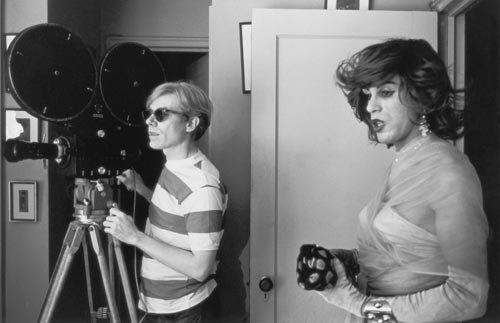 But, to return to the subject at hand, I think that the point of contention for sex and art is not that certain exchanges occur; the point is that commodity of desire into packaged securities can give and take surplus value where it is not due. It can be capitalized. Warhol, for instance, was able to create the impression of value in his mass-produced art, where I think it was not warranted. There was a certain sexiness built in to his work via his persona, which was not only not due, in my opinion, but perhaps was accumulated at the expense of those working in the Factory (the metaphor here, is simply not a metaphor). Did the unseen, anonymous "production assistants" receive any compensation for the notoriety Warhol achieved with Blow Job?
Of course, commodification exists in varying degrees in a market that, as a point of pride, claims to despise commodification. And, as I stress over and over, I do not believe that commodification is simply alienating abstraction (nor do I believe that Marx intended commodity to be thought of in this way, despite what others may think about him). But, it is true that when something as esoteric as human desire, and its partner, value, are compartmentalized into objective units, they make themselves available to capitalization, just as an open-minded, nubile artist's assistant is party to suggestion. I joke, but that is the power of the commodity of words: to imply, to suggest, to connote, and to willingly arouse.
I think one of the biggest complaints about the combination of the art-world and sex lives comes from the point of view of fairness. If one is sleeping with a gallery owner, one has an avenue to submit art to be considered that one not sleeping with the owner does not. This is a valid complain, but at the same time, it also comes from an egalitarian, democratic perspective. The supposed conclusion to be drawn from the complain is that everyone should be considered equally. Hence, blind submissions processes. There is an episode occurring in the writing world now about this very concept; it seems that certain renowned poetry and fiction prizes are actually insider popularity contests.
But then again, so what? Art is, nearly by definition, subjective. At least any superlative qualifier is subjective. And doesn't the gallery owner have to right to choose which art is hung in his/her gallery? Why not? Of course, if one gallery develops a reputation for only hanging the art of the particular tartlet that the owner is currently housing, then that is only fair.
I think that art "communities" or circles are definite popularity clubs anyhow. It's all pop these days. I might mention my wife's art on my blog, but if I wish to be known for having a fair opinion, then I would include one of those cute little "full disclosure" notes stating, 'yes, this artist and I have had our relationship blessed by the State.' Or if I wish to showcase my friends, then I could do so, but if somebody didn't like "The Interdome Set", then I could be sure that s/he would start a blog to talk shit about me. In fact, this behavior is encouraged: it's called "networking". And a network is only a social market, that (most of the time) doesn't have anything to do with sex (as much as anything can have nothing to do with sex).
And this--the commodification, and the social relations--is what we call the market, or the "Structures of Kinship", or the relations and means of production, or the scene, or anything else. Fairness, purity, and higher notions of truth upon which the work or product or relations are based, are largely bullshit, or only utilized to fool someone into doing something.
And this exegesis on markets? What is it designed to do? What is my secret objective in entering the marketplace? Well, to entertain perhaps (fat chance!), or to spell it out so that maybe one's negotiations within such a market aren't confused and befuddled in the currents and eddies. Because of course, theory is itself an art. It can be produced, commodified, and utilized to align one's reasoning in various ways and purposes. Is it true? Not necessarily, not unless it works. Right now this theory has taken up some space on this blog, and maybe occupied some of your day, if you've read all the way to the bottom. Maybe it will illuminate the human markets a bit; mostly, I hope that it just doesn't do any harm. But perhaps this is disingenuous; I do hope that it would make those who complain in the harshest of tones about how they are not "getting any" in the art/literary/culture world to maybe think twice before opening their mouths. If there is one thing I can't stand, it is people complaining about their lack of sex life: obliquely via their other inadequacies, or directly.
I can promise one thing: this blog post is in no way designed to convince anybody to sleep with me. Purity of intent by way of boring diatribe! Success!


